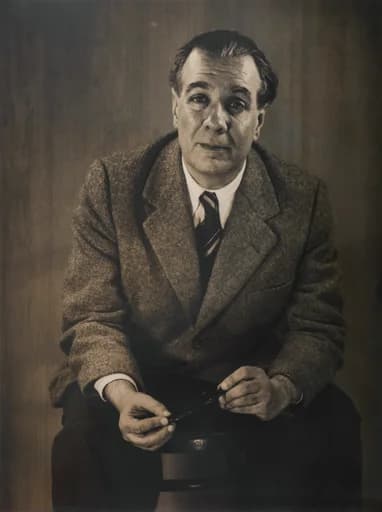
Time is the substance I am made of.
Biography
About Jorge Luis Borges
Jorge Luis Borges (1899–1986) was an Argentine poet, essayist, and short story writer whose fiction created a genre of its own: the philosophical puzzle-box story that treats labyrinths, mirrors, libraries, and infinite sets as vehicles for metaphysical inquiry. Born in Buenos Aires, he spent his youth in Geneva and Spain and returned to Argentina as a fully formed literary talent. His major collections — Ficciones (1944) and El Aleph (1949) — influenced every major novelist of the second half of the 20th century.
He was director of the Argentine National Library from 1955 to 1973, a period during which he went completely blind. Despite never winning the Nobel Prize — a famous literary injustice — he remains one of the most globally cited authors in history.
Key Themes
Quick Facts
- Born
- 1899
- Died
- 1986
- Lifespan
- 87 yrs
- Quotes
- 4 collected
Wisdom
Jorge Luis Borges's Famous Quotes
“Time is the substance I am made of.”
— A New Refutation of Time (Other Inquisitions), 1946
In this philosophical essay, Borges argues — playfully, with full awareness of its absurdity — against the existence of objective time. The personal dimension is stark: if time is a substance, and he is made of time, then the dissolution of his identity into the flow of moments is not loss but nature. Borges used philosophical argument to approach the same territory mystics approach through contemplation: the dissolution of the self into something larger.
“To fall in love is to create a religion that has a fallible god.”
— The Meeting in a Dream (Other Inquisitions), 1952
Borges was fascinated by the structure of belief and the irrationality of love throughout his fiction and essays. The "fallible god" formulation captures the precise irony he found in romantic love: you organize your entire existence around an imperfect being whom you simultaneously know to be human and treat as divine. The faith is real; its object is flawed. Borges examined this contradiction with characteristic precision and without sentimentality.
“I have always imagined that Paradise will be a kind of library.”
— Poem of the Gifts (Dreamtigers), 1960
Borges said this in several interviews after going blind in the 1950s — he was appointed director of the Argentine National Library just as his eyesight failed completely. "Poem of the Gifts" meditates on this irony: surrounded by books he could no longer read, he concluded that books and paradise are the same thing. For Borges, who had spent his childhood lost in his father''s library, the identification was not metaphorical but autobiographical.
“Reality is not always probable, or likely.”
— Columbia University Forum (interview), 1971
This observation underpins Borges''s entire fictional project: his stories routinely treat the improbable as real (a library containing every possible book, a map the same size as the territory it describes, a man who rewrites Don Quixote word-for-word but differently). For Borges, reality was not a fixed stable set of facts but a construction that has no special privilege over fiction. The improbable is merely unfamiliar, not impossible.
From the Blog
Related Reading
Discover
More Thought Leaders

Need to Know
Frequently Asked Questions
Jorge Luis Borges (1899–1986) was an Argentine poet, essayist, and short story writer whose fiction created a genre of its own: the philosophical puzzle-box story that treats labyrinths, mirrors, libraries, and infinite sets as vehicles for metaphysical inquiry. Born in Buenos Aires, he spent his youth in Geneva and Spain and returned to Argentina as a fully formed literary talent. His major collections — Ficciones (1944) and El Aleph (1949) — influenced every major novelist of the second half of the 20th century. He was director of the Argentine National Library from 1955 to 1973, a period during which he went completely blind. Despite never winning the Nobel Prize — a famous literary injustice — he remains one of the most globally cited authors in history. Jorge Luis Borges lived 1899 – 1986.
Morning Practice
Continue Your Daily Reflection
Daily faith-based affirmations and quotes from inspiring thinkers like Jorge Luis Borges.
Free access. New quotes & reflections every day.