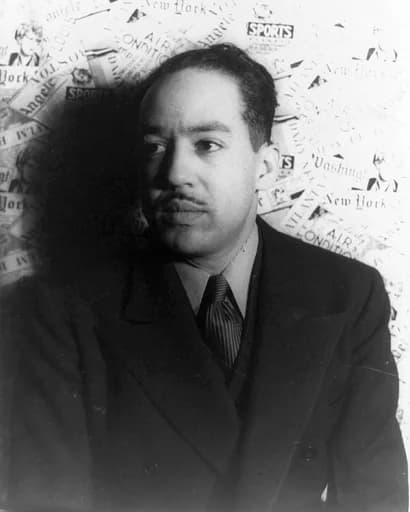
Langston Hughes
What happens to a dream deferred? Does it dry up like a raisin in the sun?
Biography
About Langston Hughes
Langston Hughes (1902–1967) was an American poet, playwright, novelist, and social activist, and the central figure of the Harlem Renaissance. Born in Joplin, Missouri, he grew up in Lawrence, Kansas, and came of age in Harlem during the 1920s cultural explosion. His debut poetry collection The Weary Blues (1926) established him as a major voice.
Hughes was distinctive for his use of blues, jazz, and vernacular Black speech as poetic forms — he argued that Black American musical and oral culture was a legitimate literary tradition, not a departure from it. His work spans over 40 books in multiple genres. He remained productive until his death in 1967, covering the rise of the Civil Rights Movement he had spent a lifetime helping to build.
Key Themes
Quick Facts
- Born
- 1902
- Died
- 1967
- Lifespan
- 65 yrs
- Quotes
- 3 collected
Wisdom
Langston Hughes's Famous Quotes
“What happens to a dream deferred? Does it dry up like a raisin in the sun?”
These opening lines of "Harlem" are among the most famous in 20th-century American poetry. Hughes poses the question that the entire poem then answers with five different images of deferred dreams — raisins, festering sores, rotten meat, sugared crusts — culminating in the explosive possibility: "Or does it explode?" Written in 1951, the poem anticipated the Civil Rights eruptions of the 1960s with remarkable precision. Lorraine Hansberry took A Raisin in the Sun directly from this poem''s central image.
“Hold fast to dreams, for if dreams die, life is a broken-winged bird that cannot fly.”
Hughes wrote "Dreams" in 1922 at age 20, during the early surge of the Harlem Renaissance, when Black American artistic life was asserting its legitimacy against a culture that systematically denied it. The broken-winged bird is an image of thwarted vitality — life technically continuing but unable to fulfill its purpose. Hughes spent his career insisting that Black Americans were not only entitled to dream but that those dreams were foundational to American culture itself.
“I, too, am America.”
"I, Too, Sing America" is Hughes''s direct response to Walt Whitman''s "I Hear America Singing" — Whitman''s celebration of American democratic life that conspicuously excluded Black Americans. Hughes writes from the position of the person sent to the kitchen when company comes, but insists on his belonging and his beauty, and predicts a future where no one will dare send him away. "I, too, am America" is the poem''s final act of claiming.
From the Blog
Related Reading
Discover
More Thought Leaders

Need to Know
Frequently Asked Questions
Langston Hughes (1902–1967) was an American poet, playwright, novelist, and social activist, and the central figure of the Harlem Renaissance. Born in Joplin, Missouri, he grew up in Lawrence, Kansas, and came of age in Harlem during the 1920s cultural explosion. His debut poetry collection The Weary Blues (1926) established him as a major voice. Hughes was distinctive for his use of blues, jazz, and vernacular Black speech as poetic forms — he argued that Black American musical and oral culture was a legitimate literary tradition, not a departure from it. His work spans over 40 books in multiple genres. He remained productive until his death in 1967, covering the rise of the Civil Rights Movement he had spent a lifetime helping to build. Langston Hughes lived 1902 – 1967.
Morning Practice
Continue Your Daily Reflection
Daily faith-based affirmations and quotes from inspiring thinkers like Langston Hughes.
Free access. New quotes & reflections every day.