You carry your homeland in your heart.
Biography
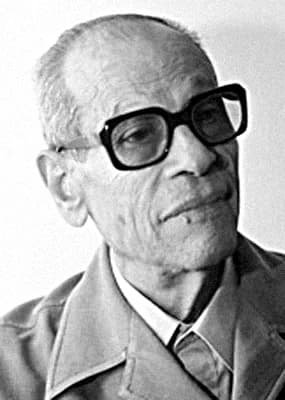
About Naguib Mahfouz
Naguib Mahfouz (1911–2006) was an Egyptian novelist who in 1988 became the first Arab writer to receive the Nobel Prize in Literature. Born in the al-Gamaliyya district of old Cairo — the setting of much of his fiction — he worked as a civil servant for decades while writing, publishing his first novels in the 1930s. His masterwork, the Cairo Trilogy (*Palace Walk*, *Palace of Desire*, *Sugar Street*, 1956–57), traced three generations of an Egyptian family from 1917 to 1944, establishing him as Egypt's Balzac.
His later existentialist novels — especially *The Thief and the Dogs* (1961) — and his allegorical novella *Children of the Alley* (1959), which was banned in Egypt for 30 years for perceived blasphemy, showed his range. In 1994 he survived a stabbing attack by an Islamic extremist, suffering permanent nerve damage to his right hand. He dictated rather than wrote for his final decade.
Key Themes
Quick Facts
- Born
- 1911
- Died
- 2006
- Lifespan
- 95 yrs
- Quotes
- 5 collected
Wisdom
Naguib Mahfouz's Famous Quotes
“You carry your homeland in your heart.”
— The Cairo Trilogy: Sugar Street (1957)
The final volume of Mahfouz's monumental Cairo Trilogy traces three generations of an Egyptian family from 1917 to the 1944 revolution, and the theme of homeland as internal rather than geographic appears throughout. Mahfouz, who rarely left Cairo, believed that place becomes identity through accumulated memory rather than physical presence — a belief that made his fiction a monument to a specific neighborhood, al-Gamaliyya, in old Cairo.
“Events at home, at work, in the street – these are the bases for a story.”
— Interview in Al-Ahram newspaper; various sources
Mahfouz — who worked as a civil servant for decades while writing, publishing articles and fiction simultaneously — drew his material relentlessly from ordinary street life in Cairo. He documented vendors, bureaucrats, café-dwellers, and neighbors with anthropological precision. He believed the extraordinary novel was assembled from the most ordinary observed detail; his entire Nobel Prize-winning career was built on this principle.
“Today's friends can be tomorrow's enemies.”
— Midaq Alley (1947)
Mahfouz's novel set in a Cairo alley during World War II portrays a community whose relationships shift rapidly under economic pressure and wartime upheaval. Friendships formed in poverty can curdle when one person achieves wealth or power; Mahfouz observed this pattern across Egypt's rapid modernization and was deeply skeptical of loyalty formed under transient conditions rather than genuine character.
“You can tell whether a man is clever by his answers. You can tell whether a man is wise by his questions.”
— Widely attributed to Mahfouz; consistent with his essay and interview positions
This distinction between cleverness and wisdom — defined by the quality of one's questions rather than answers — is a classic formulation in Arabic intellectual tradition and appears in various forms across Mahfouz's interviews and essays. He was suspicious of people who had quick answers for everything, believing that genuine understanding begins with recognizing the limits of what one knows. He received the Nobel Prize in 1988, the first Arab writer so honored.
“Fear does not prevent death. It prevents life.”
— Widely attributed to Mahfouz; exact source unverified in his published works
This aphorism circulates widely as a Mahfouz quote, particularly in Arabic-speaking countries, though the specific novel or essay source is not reliably documented. The sentiment is consistent with his worldview: Mahfouz's characters frequently die from clinging to safety rather than living fully, especially in his existentialist novels like *The Thief and the Dogs* (1961). The line deserves careful attribution until a specific source is confirmed.
From the Blog
Related Reading
Discover
More Thought Leaders
Need to Know
Frequently Asked Questions
Naguib Mahfouz (1911–2006) was an Egyptian novelist who in 1988 became the first Arab writer to receive the Nobel Prize in Literature. Born in the al-Gamaliyya district of old Cairo — the setting of much of his fiction — he worked as a civil servant for decades while writing, publishing his first novels in the 1930s. His masterwork, the Cairo Trilogy (*Palace Walk*, *Palace of Desire*, *Sugar Street*, 1956–57), traced three generations of an Egyptian family from 1917 to 1944, establishing him as Egypt's Balzac. His later existentialist novels — especially *The Thief and the Dogs* (1961) — and his allegorical novella *Children of the Alley* (1959), which was banned in Egypt for 30 years for perceived blasphemy, showed his range. In 1994 he survived a stabbing attack by an Islamic extremist, suffering permanent nerve damage to his right hand. He dictated rather than wrote for his final decade. Naguib Mahfouz lived 1911 – 2006.
Morning Practice
Continue Your Daily Reflection
Daily faith-based affirmations and quotes from inspiring thinkers like Naguib Mahfouz.
Free access. New quotes & reflections every day.