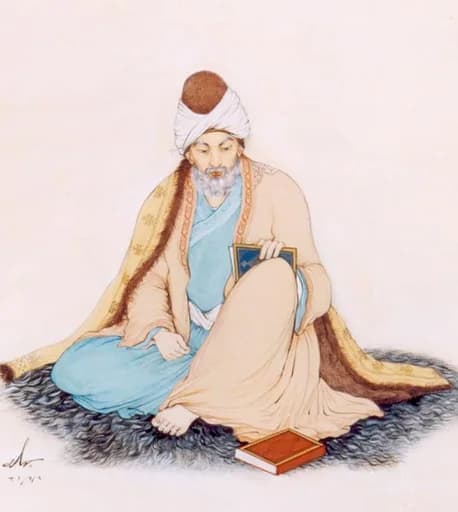
Rumi
What you seek is seeking you.
Biography
About Rumi
Jalal ad-Din Muhammad Rumi (1207–1273) was a 13th-century Persian poet, Islamic scholar, jurist, and Sufi mystic born in Khorasan (present-day Afghanistan). He spent most of his adult life in Konya (in present-day Turkey), where his spiritual transformation following the death of his teacher Shams of Tabriz unleashed one of history's most extraordinary creative outpourings. His major works include the Masnavi (a six-volume poem of over 25,000 verses) and the Divan-e Shams-e Tabrizi.
Most English "Rumi quotes" are loose adaptations rather than precise translations — Coleman Barks' influential versions, while widely read, are paraphrases of the Persian originals. Rumi's poetry is now among the best-selling poetry in the United States, read both as spiritual literature and as psychology.
Key Themes
Quick Facts
- Born
- 1207
- Died
- 1273
- Lifespan
- 66 yrs
- Quotes
- 12 collected
Wisdom
Rumi's Famous Quotes
“What you seek is seeking you.”
— Masnavi (Mathnawi), Book III — trans./adapted by Coleman Barks
In Rumi''s Sufi framework, the "seeking" refers not to ambition or desire but to the soul''s longing for divine reunion. The idea is that desire itself is a signal: the fact that you hunger for meaning, love, or truth indicates that something in the universe is already moving toward you. Rumi''s Persian original is "آنچه میجویی تو را میجوید" — the English version popularized by Coleman Barks preserves the spirit while adapting the cadence for Western readers.
“Let yourself be silently drawn by the strange pull of what you really love. It will not lead you astray.”
— Masnavi (Mathnawi) — trans./adapted by Coleman Barks
The "strange pull" in Rumi''s framework is not preference or desire in the ordinary sense but the deeper calling of the soul toward its authentic nature — what he called the soul''s longing to return to its divine origin. The promise that following it "will not lead you astray" is a Sufi confidence that authentic spiritual longing is self-correcting: unlike ego-driven desire, it leads toward union rather than fragmentation.
“Yesterday I was clever, so I wanted to change the world. Today I am wise, so I am changing myself.”
— Masnavi (Mathnawi) — attributed; trans./adapted by Coleman Barks and others
This quote articulates one of Sufism''s central psychological insights: that wisdom produces humility rather than certainty, and humility redirects energy inward rather than outward. Rumi wrote extensively about the journey from ego-driven action (trying to reshape the external world) to soul-centered transformation (reshaping the self). The shift from "clever" to "wise" is the shift from manipulation to surrender.
“The wound is the place where the Light enters you.”
— Masnavi (Mathnawi), Book II — trans./adapted by Coleman Barks
This is one of Rumi''s most quoted lines in the West, and it carries his Sufi theology of suffering: pain is not an obstacle to spiritual growth but its primary instrument. The "wound" is the place where the ego''s armor is broken, allowing divine light — which Rumi consistently associates with love and truth — to enter. He wrote this in a tradition that saw affliction not as punishment but as invitation.
“Where there is ruin, there is hope for a treasure.”
— Masnavi (Mathnawi) — trans./adapted by Coleman Barks and others
Rumi returned repeatedly to the paradox of apparent destruction containing hidden abundance. In Sufi thought, worldly ruin — whether of pride, certainty, or comfort — creates the interior space where the spiritual treasure of divine presence can be found. This is consistent with his biography: Rumi''s own spiritual transformation followed the sudden death of his beloved teacher Shams of Tabriz, an experience of devastating loss that unlocked his greatest poetry.
“Something opens our wings. Something makes boredom and hurt disappear. Someone fills the cup in front of us: We taste only sacredness.”
“Everyone has been made for some particular work, and the desire for that work has been put in every heart.”
“Let the beauty of what you love be what you do.”
“Let yourself be silently drawn by the stronger pull of what you really love.”
“Don't grieve. Anything you lose comes round in another form.”
“Respond to every call that excites your spirit.”
“Be like a tree and let the dead leaves drop.”
From the Blog
Related Reading
Discover
More Thought Leaders
Need to Know
Frequently Asked Questions
Jalal ad-Din Muhammad Rumi (1207–1273) was a 13th-century Persian poet, Islamic scholar, jurist, and Sufi mystic born in Khorasan (present-day Afghanistan). He spent most of his adult life in Konya (in present-day Turkey), where his spiritual transformation following the death of his teacher Shams of Tabriz unleashed one of history's most extraordinary creative outpourings. His major works include the Masnavi (a six-volume poem of over 25,000 verses) and the Divan-e Shams-e Tabrizi. Most English "Rumi quotes" are loose adaptations rather than precise translations — Coleman Barks' influential versions, while widely read, are paraphrases of the Persian originals. Rumi's poetry is now among the best-selling poetry in the United States, read both as spiritual literature and as psychology. Rumi lived 1207 – 1273.
Morning Practice
Continue Your Daily Reflection
Daily faith-based affirmations and quotes from inspiring thinkers like Rumi.
Free access. New quotes & reflections every day.