The 2 AM Spiral: Intrusive Thoughts, Faith, and How to Get Through the Night
It is dark and your brain has decided to replay every mistake since 2014. You are not alone, not crazy, and there are things — clinical and spiritual — that actually help.
12 de maio de 2026 · Atualizado 1 de setembro de 2026 · 7 min de leitura
Neste artigo· 5
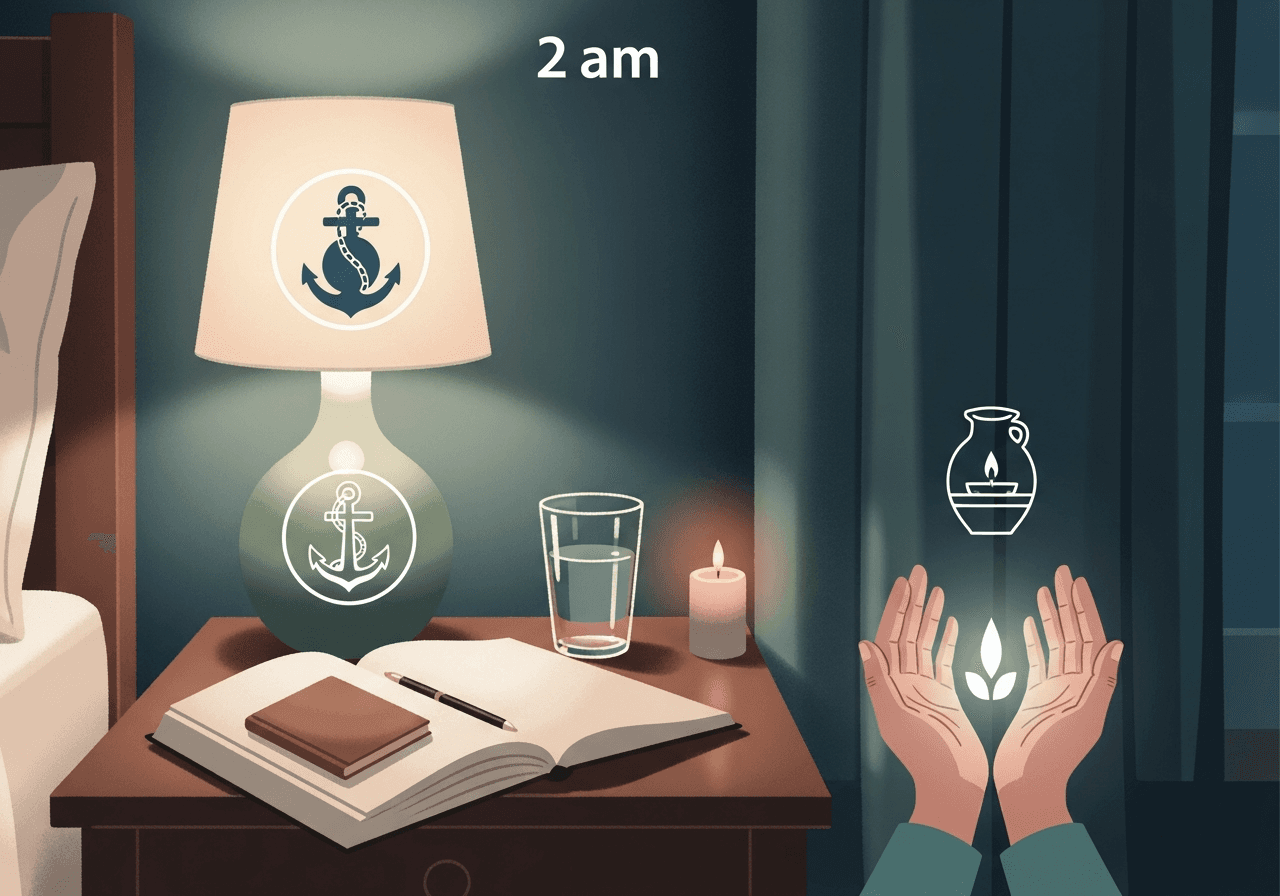
It is dark. The house is quiet. And your brain has decided that this is the right moment to replay every mistake you have made since 2014, audit every relationship in your life, and predict three catastrophes by sunrise. The thoughts are sharp, intrusive, often unreasonable, and impossible to argue with. You are not alone, you are not crazy, and there are things — clinical and spiritual — that actually help.
The Honest Framing
Mental health professionals describe intrusive thoughts as unwanted, often distressing mental content that arrives uninvited. They are extremely common — research suggests nearly all adults experience them. They become a clinical concern when they are frequent, distressing, and difficult to disengage from (a feature of anxiety disorders, OCD, depression, and PTSD).
Scripture does not use clinical language but is full of people who could not sleep — David crying out in the night, Job complaining of weariness, Asaph saying "I am so troubled that I cannot speak" (Psalm 77:4 KJV). The Bible is honest about the wakeful dark. It also offers practices for what to do in it.
Consider a familiar pattern: a thirty-something who has been managing a stressful work project finally falls asleep around 11 p.m. and wakes at 2:17 a.m. with her heart racing. The brain immediately serves up: a missed deadline, the email she should have phrased differently, a fight she had with her sister in 2019, the suspicion that her boss is annoyed with her, the realization that she has not called her grandmother in three weeks. Each thought arrives with the certainty of fact. None of them feels arguable. By 4 a.m. she has convinced herself that her career is over, her family thinks she is selfish, and the strange ache in her left shoulder is probably a tumor. By 7 a.m. when the alarm goes off, none of those concerns feel real anymore. That is the 2 a.m. spiral, and the loudness of the thoughts has nothing to do with their truth.
What the Research Says
Cognitive-behavioral research on intrusive thoughts has produced a counter-intuitive finding: trying to suppress an intrusive thought tends to amplify it. The "white bear effect" — Daniel Wegner's foundational research on thought suppression — showed that effortfully not thinking about something increases its frequency. The clinical move is not to suppress but to acknowledge, label, and redirect.
The American Psychological Association notes that nighttime is physiologically tilted toward rumination. Cortisol naturally rises in the early morning hours, the prefrontal cortex (the brain's regulator) is less active during sleep transitions, and the absence of daytime stimuli leaves the mind free to chase its own loops. None of this means something is wrong with you. It means your brain is doing what brains do at 2 a.m. when nothing else is competing for attention.
Susan Nolen-Hoeksema, a psychologist at Yale University whose research on rumination spanned over two decades until her death in 2013, identified rumination as one of the strongest predictors of depression onset, duration, and recurrence. Her studies, published in journals including the Journal of Personality and Social Psychology and the Journal of Abnormal Psychology, distinguished rumination — repetitive, passive focus on distress without movement toward solution — from problem-solving thinking. The midnight spiral is rumination's natural habitat: passive, repetitive, looping, never resolving. Her clinical work showed that distraction, redirection toward concrete action, and active behavioral interventions (including getting out of bed) interrupt rumination more reliably than trying to "think through" the loop. The faithfulness implication aligns precisely: scripture's prescription is not to argue with the thought but to redirect attention — "think on these things" — to a different anchor entirely.
What Scripture Says
Mark 4:38-39 KJV — Jesus is asleep in a boat during a storm. The disciples wake him. He commands the storm: "Peace, be still." Notice the texture of this passage. The storm is real. The fear is real. The command is real. Jesus does not tell the disciples the storm is imaginary. He addresses it.
Philippians 4:8 KJV — "Whatsoever things are true, whatsoever things are honest, whatsoever things are just, whatsoever things are pure, whatsoever things are lovely, whatsoever things are of good report... think on these things." Paul is prescribing a deliberate redirection of attention. Modern clinical psychology calls this cognitive restructuring. Paul calls it the path to peace.
Psalm 4:8 KJV — "I will both lay me down in peace, and sleep: for thou, LORD, only makest me dwell in safety." Sleep here is not the absence of trouble. It is trust deposited where vigilance used to live.
Practices That Integrate Both
- Name the thought. Out loud or in your head: "This is an intrusive thought. Brain doing its 2 a.m. thing." Naming creates distance between you and the thought. You are not the thought. You are the one observing it.
- Do not argue with it. Reasoning with a 2 a.m. spiral rarely works because the spiral is not reasonable. Acknowledge and redirect, do not debate.
- Use a short prayer or scripture as the redirect. "The Lord is my shepherd" (Psalm 23:1 KJV). "Cast all your care upon him; for he careth for you" (1 Peter 5:7 KJV). One short phrase repeated. Borrow words when your own are not working.
- Engage the body. Slow breathing (longer exhale than inhale), feet on the floor, a sip of water. The body's regulation helps the mind's regulation. Praying in a flooded state often deepens the flood.
- Get up briefly if you cannot fall back asleep. Sleep researchers recommend leaving the bed after twenty minutes of wakefulness — read something dull in low light, then return. The bed should not become the place where the spiral lives.
- Capture the thought, then close the loop. Because half the loop's power is the fear that you will forget the important thing and need to keep rehearsing it. How: keep a notebook by the bed. When the thought insists, write it down in one sentence ("call grandma," "send the email"). The brain releases what it knows is recorded.
- Pre-decide a redirect script before you need it. Because at 2 a.m. you do not have the cognitive bandwidth to invent a strategy from scratch. How: while you are calm during the day, write out exactly what you will do when the spiral starts — the phrase you will repeat, the breath pattern you will use, the action you will take if it does not pass in twenty minutes. Pre-deciding outperforms in-the-moment problem-solving every time.
When to Seek Help
Consult a licensed mental health professional if intrusive thoughts are: occurring most nights, severely disrupting sleep more than three weeks, accompanied by daytime anxiety or panic, content that frightens you (violent, self-harm, religious scrupulosity, taboo themes — many of these are features of OCD and are highly treatable but require specialized care), accompanied by trauma flashbacks or nightmares (possible PTSD), paired with depression or hopelessness, producing compulsive checking or rituals you cannot stop, accompanied by physical panic symptoms that wake you (racing heart, sweating, sense of doom), or include any thoughts of suicide. Particular triage signals that warrant faster outreach: intrusive thoughts of harming yourself or others (these are common in OCD and are NOT predictive of action, but they require clinical evaluation), intrusive thoughts that intensify after religious or contemplative practice (scrupulosity OCD), intrusive thoughts paired with sleep deprivation of more than a week (sleep deprivation amplifies all psychiatric symptoms), and intrusive thoughts in new mothers (postpartum OCD and postpartum depression are treatable but often missed). Sleep disorders, anxiety disorders, OCD, and depression are all treatable conditions. The American Association of Christian Counselors (aacc.net) maintains a directory of faith-integrated clinicians.
If you are in crisis or having thoughts of suicide, call or text 988 — the Suicide and Crisis Lifeline. Available 24/7, including 2 a.m.
The thoughts at 2 a.m. are not true just because they are loud. The dark is real. The fear is real. So is the One who sleeps in the boat, the One who said "peace, be still," and the morning that is, in fact, coming. You can get through the night. People have for thousands of years. You are not alone in this one.
Related reading
Anxiety wears many faces. These sit close to what you may be carrying:
- #intrusive thoughts
- #anxiety
- #sleep
- #faith
- #mental health
- #rumination
Escrevo sobre fé, motivação e bem-estar mental porque acredito que uma palavra de Deus pode mudar tudo. Os artigos do Mental Compass são pesquisados em estudos publicados e fontes clínicas. Eles existem para encorajar e informar, não para substituir o cuidado de um profissional licenciado.