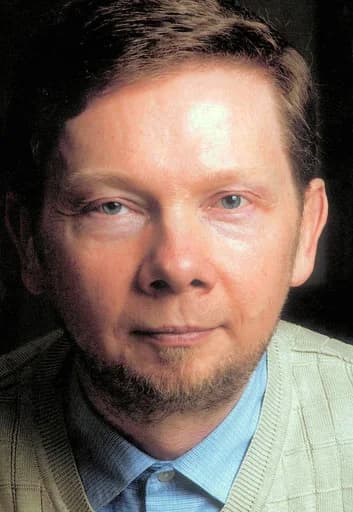
Eckhart Tolle
Life will give you whatever experience is most helpful for the evolution of your consciousness.
Biography
About Eckhart Tolle
" His teachings focus on the importance of presence, mindfulness, and awakening to one's true self. Tolle's work has inspired millions to live more consciously and find peace in the present moment.
Key Themes
Quick Facts
- Born
- 1948
- Status
- Living
- Age
- 78 yrs
- Quotes
- 8 collected
Photo: Kyle Hoobin (twitter.com/kylehoobin) / CC BY-SA 3.0 / Source Resized and converted to WebP from the original.
Wisdom
Eckhart Tolle's Famous Quotes
“Life will give you whatever experience is most helpful for the evolution of your consciousness.”
This is Tolle''s teaching on the function of difficulty in spiritual development, drawn from his own biography: his transformation occurred at a moment of complete psychological breakdown in his late twenties. His framework suggests that life''s painful experiences are not random but calibrated — they produce exactly the friction needed to dissolve the ego structures blocking deeper awareness. This is not fatalism but trust in a developmental process.
“To love is to recognize yourself in another.”
Tolle argues that recognition — genuinely seeing another person''s being beneath their story and role — is itself a form of love. This connects to his teaching that the primary human need is not for things but for presence: to be seen and met at the level of being rather than function. The implication is that love is not primarily a feeling that arises but an act of attention that you extend.
“Whatever you think the world is withholding from you, you are withholding from the world.”
This is one of Tolle''s most structurally precise insights: if you believe the world is withholding love, kindness, or recognition from you, examine whether you are giving those things freely. The universe, he argues, does not operate as a vault that must be opened before it dispenses — it mirrors. What you perceive as deprivation in the world is often a projection of what you are withholding from it.
“The primary cause of unhappiness is never the situation but your thoughts about it.”
This is the core of Tolle''s psychological teaching: emotions are produced by thoughts, not by events. The same situation generates radically different emotional states depending on the story the mind constructs around it. His practical implication: before trying to change circumstances, examine the thoughts labeling those circumstances as unbearable. The suffering usually lives in the interpretation, not the fact.
“Realize deeply that the present moment is all you ever have.”
This is the title thesis of Tolle''s first book, grounded in the observation that past and future are mental constructs — memories and projections experienced in a present moment. Anxiety lives in projection; regret lives in memory. The present moment is the only place where action, choice, and awareness are actually possible. His book builds an entire practice around returning to this simple recognition as the foundation of peace.
“Worry pretends to be necessary but serves no useful purpose.”
Tolle is careful to say "pretends" — worry presents itself as useful problem-solving but is structurally incapable of producing solutions. Worry rehearses problems without resolving them, generating the feeling of activity while consuming present-moment awareness. His alternative is not passive optimism but alert action from a clear mind — addressing what can actually be addressed now, rather than spinning on what cannot.
“Some changes look negative on the surface but you will soon realize that space is being created in your life for something new to emerge.”
Tolle argues that what looks like loss or disruption — a job ending, a relationship dissolving, a plan failing — is often life''s way of dissolving a structure that had become too rigid to allow growth. This reframe does not deny the pain of loss but invites a different question: not "why is this happening to me?" but "what is this making room for?" The teaching is a practical application of his broader thesis that resistance to change is the primary source of suffering.
“Acknowledging the good that you already have in your life is the foundation for all abundance.”
Tolle draws on the teaching of gratitude found across contemplative traditions but gives it a specific mechanism: acknowledging what is already present activates a different state of consciousness than cataloguing what is absent. Abundance, in his framing, is not primarily a material condition but a quality of awareness — recognizing that the present moment already contains more than the ego''s "not enough" story admits.
From the Blog
Related Reading
Discover
More Thought Leaders
Need to Know
Frequently Asked Questions
Eckhart Tolle is a renowned spiritual teacher and author, best known for his books "The Power of Now" and "A New Earth." His teachings focus on the importance of presence, mindfulness, and awakening to one's true self. Tolle's work has inspired millions to live more consciously and find peace in the present moment. Eckhart Tolle lived b. 1948.
Morning Practice
Continue Your Daily Reflection
Daily faith-based affirmations and quotes from inspiring thinkers like Eckhart Tolle.
Free access. New quotes & reflections every day.