Feet, what do I need you for when I have wings to fly?
Biography
About Frida Kahlo
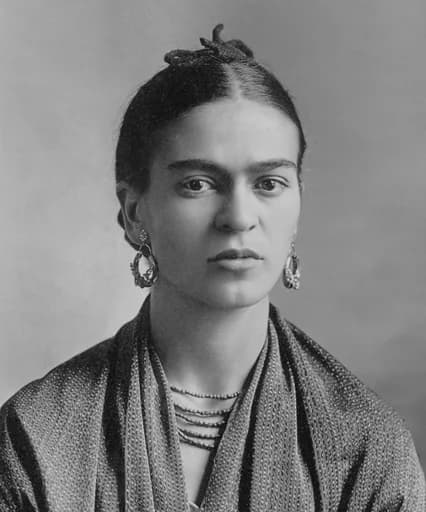
Frida Kahlo (1907–1954) was a Mexican painter whose vivid self-portraits and intensely personal imagery made her one of the most recognizable and studied artists of the 20th century. At 6 she contracted polio; at 18 she survived a bus accident that fractured her spine, pelvis, collarbone, and crushed her right leg — initiating a lifetime of medical procedures (35+ surgeries) and chronic pain. Confined to recovery, she began painting.
Her work, often dismissed by the Surrealists as autobiography, is now understood as a precise phenomenological record of her physical and emotional experience. She was deeply involved in Mexican politics and culture, and her turbulent relationship with muralist Diego Rivera defined much of her adult life. Her diary, published posthumously, reveals the full scope of her literary imagination.
Key Themes
Quick Facts
- Born
- 1907
- Died
- 1954
- Lifespan
- 47 yrs
- Quotes
- 5 collected
Wisdom
Frida Kahlo's Famous Quotes
“Feet, what do I need you for when I have wings to fly?”
— The Diary of Frida Kahlo: An Intimate Self-Portrait (1944–1954)
Kahlo wrote this in her diary during the period when her foot was amputated in 1953, following years of complications from her childhood polio and the 1925 bus accident that shattered her spine and pelvis. The line is a declaration of refusal: physical limitation cannot ground a spirit determined to fly. It is her most condensed statement of the relationship between her disabled body and her expansive creative imagination.
“I never paint dreams or nightmares. I paint my own reality.”
— Widely attributed — from various interviews; consistent with her documented statements on her work
Kahlo made this distinction in response to André Breton''s labeling of her work as Surrealist — she rejected the classification. Surrealism depicts the irrational; her paintings depicted what she experienced as the actual texture of living: pain, longing, hybrid identity, bodily violation. The self-portraits that showed her spine as a crumbling column or her heart extracted and displayed were not dreams. They were her precise report of what it felt like to be her.
“I am my own muse, I am the subject I know best. The subject I want to know better.”
— From diary entries and interviews — consistent with her documented statements
Kahlo''s choice of self-portrait as her primary form was both circumstantial and philosophical. Confined to bed during her long recovery, she had only herself to observe. But she made a creative virtue of this: over 55 of her approximately 150 paintings are self-portraits. Each is an experiment in seeing herself clearly — not flatteringly, not harshly, but with the same precision an anthropologist might bring to documenting a subject.
“I paint self-portraits because I am so often alone, because I am the person I know best.”
— Widely attributed — from various documented sources and interviews
Kahlo''s life was marked by prolonged physical isolation — months and years in hospital beds and corrective corsets — that forced a radical inward turn. Her prolific self-portraiture was not narcissism but the natural consequence of this situation: she had sustained, intimate access to one subject. The exploration was also philosophical: who is this person who has endured all this? The question never stopped being interesting to her.
“At the end of the day, we can endure much more than we think we can.”
— Widely attributed to Kahlo — consistent with documented statements and her biography
Kahlo spent most of her adult life in physical pain — she underwent over 35 surgeries after her accident and lived with chronic infection and disability. That she continued painting, creating a body of work now among the most valued in Mexican art history, is a sustained demonstration of this claim. The endurance she describes is not passive suffering but active creative will working alongside pain.
From the Blog
Related Reading
Discover
More Thought Leaders

Need to Know
Frequently Asked Questions
Frida Kahlo (1907–1954) was a Mexican painter whose vivid self-portraits and intensely personal imagery made her one of the most recognizable and studied artists of the 20th century. At 6 she contracted polio; at 18 she survived a bus accident that fractured her spine, pelvis, collarbone, and crushed her right leg — initiating a lifetime of medical procedures (35+ surgeries) and chronic pain. Confined to recovery, she began painting. Her work, often dismissed by the Surrealists as autobiography, is now understood as a precise phenomenological record of her physical and emotional experience. She was deeply involved in Mexican politics and culture, and her turbulent relationship with muralist Diego Rivera defined much of her adult life. Her diary, published posthumously, reveals the full scope of her literary imagination. Frida Kahlo lived 1907 – 1954.
Morning Practice
Continue Your Daily Reflection
Daily faith-based affirmations and quotes from inspiring thinkers like Frida Kahlo.
Free access. New quotes & reflections every day.