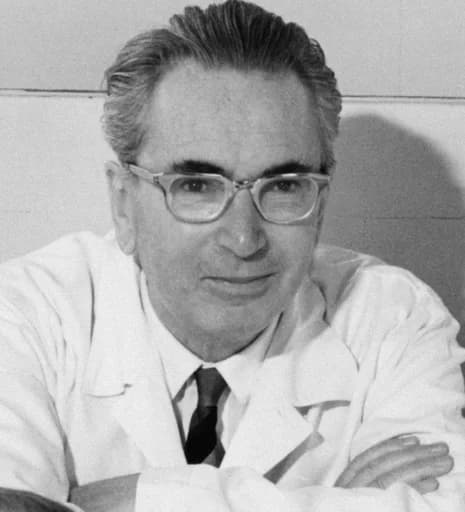
Viktor Frankl
Live as if you were living already for the second time and as if you had acted the first time as wrongly as you are about to act now.
Biography
About Viktor Frankl
Viktor Frankl (1905–1997) was an Austrian neurologist, psychiatrist, and Holocaust survivor who founded logotherapy, a school of psychotherapy built on the human search for meaning. Born in Vienna, he earned doctorates in both medicine and philosophy and led the neurology department at Vienna's Rothschild Hospital before the Nazi annexation of Austria. From 1942 to 1945 he was imprisoned in four concentration camps, including Auschwitz and Dachau, where his wife, parents, and brother were killed.
Out of that experience he wrote Man's Search for Meaning (1946), one of the most influential books of the twentieth century, arguing that even in the most degrading suffering life retains meaning, and that the freedom to choose one's attitude can never be taken away. After the war he was professor of neurology and psychiatry at the University of Vienna and lectured around the world. His work bridges psychology and faith and remains foundational to existential therapy, grief counseling, and modern resilience research.
Key Themes
Quick Facts
- Born
- 1905
- Died
- 1997
- Lifespan
- 92 yrs
- Quotes
- 12 collected
Photo: Prof. Dr. Franz Vesely / CC BY-SA 3.0 de / Source Resized and converted to WebP from the original.
Wisdom
Viktor Frankl's Famous Quotes
“Live as if you were living already for the second time and as if you had acted the first time as wrongly as you are about to act now.”
— Man's Search for Meaning, 1946
Frankl used this as a practical logotherapy exercise. Imagining your present choice as a past mistake you now get to correct sharpens conscience and clarifies how to act.
“Love is the only way to grasp another human being in the innermost core of his personality.”
— Man's Search for Meaning, 1946
Even in Auschwitz, Frankl found that picturing his wife sustained him. He concluded that love reaches a person's essence — independent of whether the beloved is present, or even alive.
“An abnormal reaction to an abnormal situation is normal behavior.”
— Man's Search for Meaning, 1946
Frankl wrote this of prisoners' psychological responses in the camps. It remains a foundational reframing in trauma work: distress in the face of horror is not pathology but a sane response to an insane reality.
“Those who have a 'why' to live can bear with almost any 'how'.”
— Man's Search for Meaning, 1946
Frankl borrowed this line from Friedrich Nietzsche and made it the backbone of logotherapy. In the camps he saw that prisoners who held onto a concrete future task — a book to finish, a loved one to find — were far more likely to survive.
“Life is never made unbearable by circumstances, but only by lack of meaning and purpose.”
— Man's Search for Meaning, 1946
A direct challenge to the idea that hardship alone breaks people. Frankl located despair not in external conditions but in the absence of a reason to endure them.
“Ultimately, man should not ask what the meaning of his life is, but rather he must recognize that it is he who is asked.”
— Man's Search for Meaning, 1946
Frankl reversed the usual question. Meaning is not a riddle handed to us to solve in the abstract; it is a demand life makes of us, answered through concrete responsible action.
“Fundamentally, therefore, any man can, even under such circumstances, decide what shall become of him—mentally and spiritually.”
— Man's Search for Meaning, 1946
Against the determinism that says environment dictates character, Frankl insisted that the freedom to shape one's inner life survives even the camp. Dignity is a decision, not a circumstance.
“When a man finds that it is his destiny to suffer, he will have to accept his suffering as his task; his single and unique task.”
— Man's Search for Meaning, 1946
Frankl reframed unavoidable suffering as a vocation. The way a person bears an unchangeable burden, he taught, becomes a unique moral achievement available to no one else.
“Happiness cannot be pursued; it must ensue. One must have a reason to be happy.”
— Man's Search for Meaning, 1946
Frankl argued that chasing happiness directly defeats it. Joy arrives as a byproduct of devotion to something beyond oneself — never as the target of the pursuit.
“Everything can be taken from a man but one thing: the last of the human freedoms—to choose one's attitude in any given set of circumstances, to choose one's own way.”
— Man's Search for Meaning, 1946
This is the cornerstone of logotherapy, drawn from Frankl's observation of fellow prisoners who gave away their last bread to comfort others. He argued that the Nazis could control every external circumstance but never a person's inner response — the one freedom that cannot be confiscated.
“When we are no longer able to change a situation, we are challenged to change ourselves.”
— Man's Search for Meaning, 1946
Frankl distinguished between suffering we can remove and suffering we cannot. When circumstances are fixed, he taught, growth comes from transforming our relationship to them rather than from futile resistance.
“Suffering ceases to be suffering at the moment it finds a meaning.”
— Man's Search for Meaning, 1946
For Frankl, pain itself was not redemptive — but pain interpreted within a larger purpose became bearable. Meaning did not erase the suffering; it changed what the suffering was.
From the Blog
Related Reading
Discover
More Thought Leaders
Need to Know
Frequently Asked Questions
Viktor Frankl (1905–1997) was an Austrian neurologist, psychiatrist, and Holocaust survivor who founded logotherapy, a school of psychotherapy built on the human search for meaning. Born in Vienna, he earned doctorates in both medicine and philosophy and led the neurology department at Vienna's Rothschild Hospital before the Nazi annexation of Austria. From 1942 to 1945 he was imprisoned in four concentration camps, including Auschwitz and Dachau, where his wife, parents, and brother were killed. Out of that experience he wrote Man's Search for Meaning (1946), one of the most influential books of the twentieth century, arguing that even in the most degrading suffering life retains meaning, and that the freedom to choose one's attitude can never be taken away. After the war he was professor of neurology and psychiatry at the University of Vienna and lectured around the world. His work bridges psychology and faith and remains foundational to existential therapy, grief counseling, and modern resilience research. Viktor Frankl lived 1905 – 1997.
Morning Practice
Continue Your Daily Reflection
Daily faith-based affirmations and quotes from inspiring thinkers like Viktor Frankl.
Free access. New quotes & reflections every day.