How to Pray When You're Anxious (Practical Scripts)
When anxiety hits, "just pray about it" can feel impossible. Here are short, breath-paced prayer scripts you can actually use mid-spiral — honest about prayer's place alongside professional care.
May 4, 2026 · Updated September 1, 2026 · 8 min read

In this article· 5
This is educational content, not clinical advice. Prayer can be a steadying companion in anxiety, but it is not a treatment for an anxiety disorder, panic disorder, or any clinical condition. If you are in crisis or thinking about harming yourself, call or text the 988 Suicide & Crisis Lifeline (call or text 988 in the US) right now. You can reach them 24/7.
You already know the advice. Just pray about it. And maybe, on a calm afternoon, you can. But anxiety rarely waits for calm afternoons. It shows up at 2 a.m. with your heart slamming and your thoughts running in tight, fast circles. You go to pray and the words won't come — or they come and immediately scatter. So you conclude you're doing faith wrong, on top of everything else.
You're not. The problem isn't your faith. It's that most prayer advice assumes a brain that can sit still and form sentences — exactly the brain anxiety takes offline first. What you need mid-spiral isn't a sermon about prayer. You need words short enough to survive a racing mind, paced to your breath, repeatable when you can't think. That's what this is.
Why prayer is hard when you're anxious
Anxiety is not a thinking problem you can out-reason in the moment. It's a whole-body alarm state. When your threat system fires, blood and attention shift toward fast, defensive responses, and the slow, deliberative part of your brain — the part that composes a thoughtful prayer — gets crowded out. This is why "just calm down and pray" lands like an insult. The machinery you'd use to do it is the machinery currently busy sounding an alarm.
This is also why pacing your breath matters before pacing your words. The American Psychological Association describes slow, controlled breathing as a well-established way to down-regulate the body's stress response — it's one of the most accessible tools for moving out of acute fight-or-flight. The National Institute of Mental Health notes that anxiety disorders are common, treatable, and best addressed with professional care when symptoms persist or interfere with daily life. None of that competes with prayer. It's the on-ramp to it. When the body settles even slightly, words become possible again.
So the scripts below are deliberately short and breath-shaped. You are not trying to pray well. You are trying to pray at all — and short, true, repeated is more than enough.
What prayer is and isn't here
Let's be honest about what these scripts are for. They are a way to stay tethered to God when your own words fail. They are not a replacement for therapy, medication, or a clinician's care, and using them does not mean you lack faith. If anything, Scripture anticipates the exact moment you're in:
"Likewise the Spirit also helpeth our infirmities: for we know not what we should pray for as we ought: but the Spirit itself maketh intercession for us with groanings which cannot be uttered." — Romans 8:26 (KJV)
Read that slowly. We know not what we should pray for as we ought. The Bible names wordless prayer as normal — even as the place where the Spirit does the work you can't. So if all you can manage tonight is a groan, a name, a single line on repeat, that is not a failed prayer. According to this verse, that may be the truest kind.
Hold both things at once: prayer steadies the soul, and professional care treats the condition. Faith communities sometimes pressure people to choose. Don't. Seeing a therapist is not a spiritual downgrade, and taking prescribed medication is not a lack of trust. The most faithful thing you can do with clinical anxiety is treat it like the real health issue it is — and keep praying through it.
Short prayer scripts you can actually use
Pick whichever fits the moment. Say it slowly. Repeat it as many times as you need. Pair it with breath: inhale on the first half, exhale on the second.
1. The one-line breath prayer. When you can't manage anything else, you can manage four words. Breathe in on the first two, out on the last two:
"What time I am afraid... I will trust in thee." — Psalm 56:3 (KJV)
That's the whole prayer. Loop it. The point isn't to feel instantly calm; it's to give your scattered mind one rail to hold.
2. The 5-4-3-2-1 grounding prayer. Anxiety pulls you out of the present; this pulls you back, with God in each step. Slowly, name them aloud or in your head:
- Lord, here are 5 things I can see, and You made each one.
- 4 things I can touch — I am here, in this body You gave me.
- 3 things I can hear — You are not absent from this room.
- 2 things I can smell — You are nearer than my next breath.
- 1 thing I am grateful for — even now, even small.
- Then: "I sought the LORD, and he heard me, and delivered me from all my fears." — Psalm 34:4 (KJV)
3. The Lord's Prayer, in pieces. When a full prayer is too much, pray one line, breathe, then the next. You don't have to finish:
"Our Father which art in heaven, Hallowed be thy name. ... Give us this day our daily bread. ... Deliver us from evil." — from Matthew 6:9-13 (KJV)
Just Our Father is a complete place to stop. The prayer holds even when you can't.
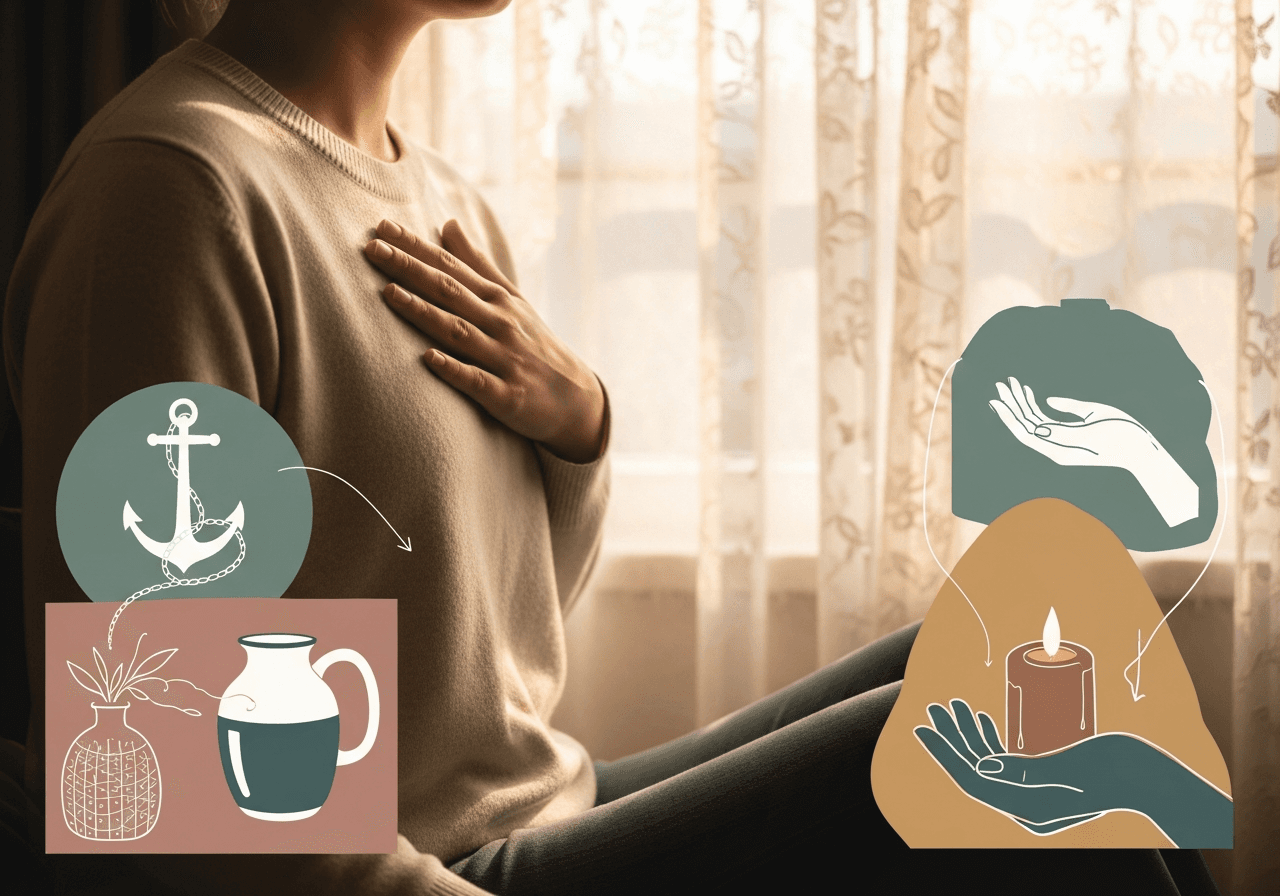
4. The "cast it" prayer. When the worry is a specific, named thing, hand it over with your hands. Open your palms, and as you exhale:
"Casting all your care upon him; for he careth for you." — 1 Peter 5:7 (KJV)
God, here is the thing I keep gripping. I'm setting it in Your hands for tonight. I'll pick it back up tomorrow if I must — but not now.
5. A lament script. You don't have to be calm or grateful to pray. The Psalms model raw honesty, and so can you:
God, I'm not okay. My chest is tight and my mind won't stop and I'm scared. I don't have tidy words. The psalmist didn't always either. So I'm just telling You the truth: this is hard, and I need You here. Philippians 4:6-7 says to bring You everything "with thanksgiving" — so even this, the mess of it, I bring to You.
6. A script for the middle of the night. When you wake at 3 a.m. with your heart pounding, don't fight to fall back asleep. Breathe slow, and pray small, on a loop:
Be still. You are here. — Psalm 56:3: "What time I am afraid, I will trust in thee."
Lord, I don't need answers right now. I just need to get to morning. Keep me company until then.
When to reach for more than prayer
Prayer is a companion, not a triage tool. Use this list honestly. If any of these are true, prayer alongside professional help — not prayer instead of it — is the faithful next step:
- Anxiety or panic is happening most days, or interfering with work, sleep, eating, or relationships.
- You're avoiding important parts of your life to dodge the anxiety.
- Panic attacks are frequent, or you're increasingly afraid of the next one.
- You're using alcohol or substances to manage the feelings.
- The dread doesn't lift, or it's getting worse over weeks.
The NIMH point bears repeating: anxiety disorders are treatable, and reaching out for care is effective — not a weakness, and not a faith problem. A licensed therapist or your doctor is the right starting place for diagnosis and treatment. Nothing here replaces that conversation.
If you are in crisis — thinking about suicide, in danger, or unable to keep yourself safe — contact the 988 Suicide & Crisis Lifeline now. Call or text 988 (US), 24/7, free and confidential. Outside the US, please contact your local emergency number or crisis line. This article cannot and does not replace emergency help.
A closing word
Some nights the most honest prayer you have is one word and a held breath. That counts. Anxiety wants you to believe that because you can't pray eloquently, you've lost the line to God. The opposite is true: the Spirit itself maketh intercession for us with groanings which cannot be uttered. The line was never held up by your eloquence. It's held by Him.
So keep the scripts close. Use them at 2 a.m. Pair them with the breathing, the grounding, the phone call to a therapist you've been putting off. None of that is unspiritual. It's what it looks like to be a whole person — body, mind, and soul — held by a God who meets you exactly where the words run out.
This article is educational content, not clinical or therapeutic advice. The author is not a licensed mental health professional. Prayer can support emotional well-being but does not diagnose or treat any medical or psychological condition; please consult a licensed clinician for diagnosis and care. If you are in crisis, contact the 988 Suicide & Crisis Lifeline (call or text 988 in the US) or your local emergency services.
Related
- Bible Verses About Anxiety — and What They Actually Mean
- How to Stop Worrying: A Faith + Science Toolkit
- Is Anxiety a Sin? An Honest Biblical and Clinical Answer
Related reading
Anxiety wears many faces. These sit close to what you may be carrying:
- Faith and mental health: the fuller picture
- How to stop worrying: faith and the science
- Is anxiety a sin? A biblical answer
About the author. This article was written by Diosh Lequiron, founder of Motivational Inspiration and a lifelong follower of Christ (dioshlequiron.com). It is written from a broadly historic, ecumenical Christian perspective — not the position of any single denomination — and is offered as reflection, not doctrinal instruction; the author writes as a lay student of Scripture, not an ordained minister. Scripture is quoted from the King James Version (KJV). This article is educational and not clinical advice; as stated above, the author is not a licensed mental-health professional, and crisis resources are provided in the text. Articles may use AI assistance for drafting, research, and editing; all content is reviewed and edited by a human before publication.
- #Prayer
- #Anxiety
- #Faith
- #Mental Health
- #Spiritual Practice
I write about faith, motivation, and mental wellness because I believe one word from God can change everything. Mental Compass articles are researched against published studies and clinical sources. They are here to encourage and inform, not to replace care from a licensed professional.