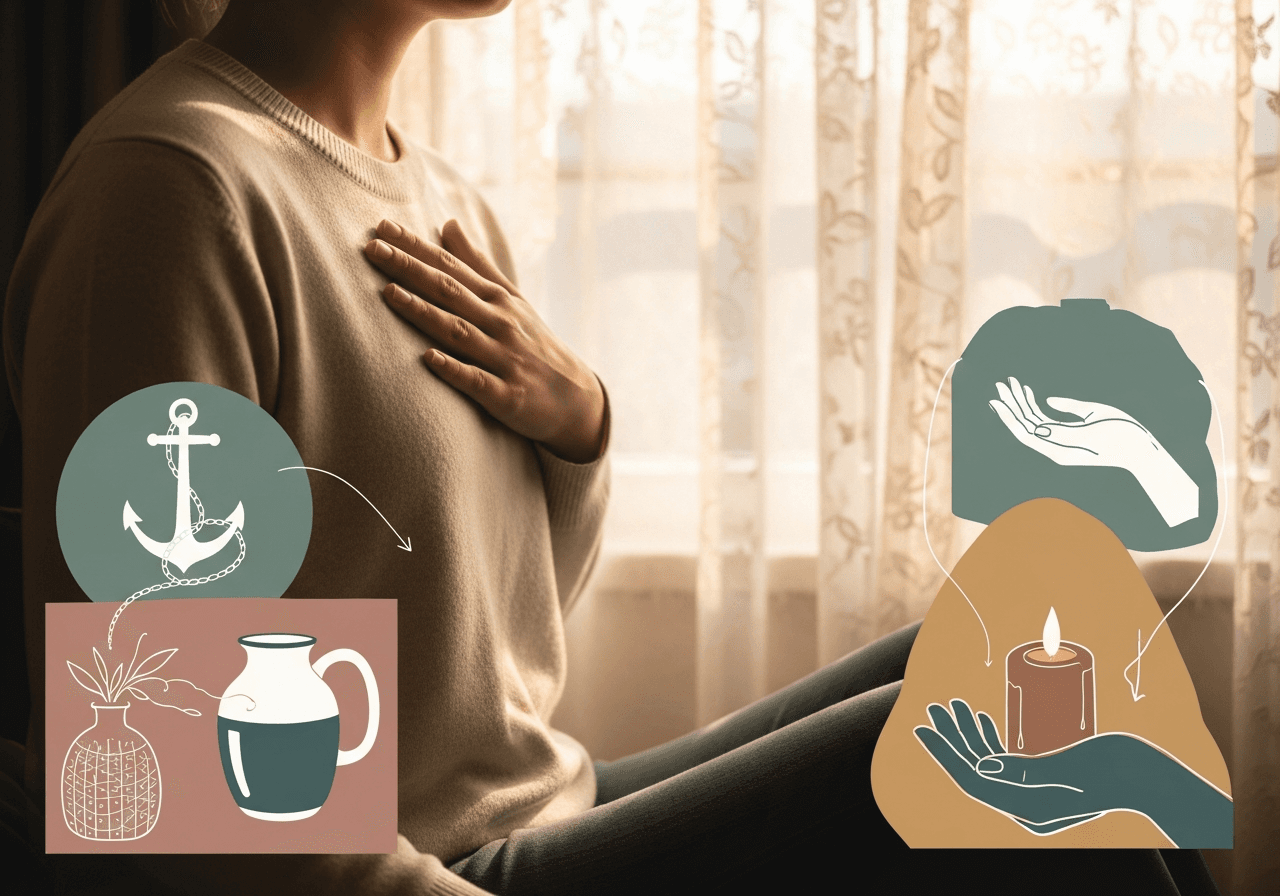
When a Panic Attack Hits: A Faith-Aware First-Aid Guide
A panic attack is not a faith failure. It is a nervous system in temporary overdrive — and there is a way through it that honors both clinical care and prayer.
May 13, 2026 · Updated September 1, 2026 · 5 min read

In this article· 5
If you have ever had a panic attack, you know it does not feel like garden-variety anxiety. It feels like dying. Chest tightness. Air that will not fill the lungs. A heart that pounds against your ribs like a fist on a door. The thought, I cannot survive this, arriving with the certainty of a verdict.
You are not dying. You are also not weak, faithless, or losing your mind. You are having a panic attack — a discrete event with a defined shape, a definable physiology, and a definable arc. It will end. You can learn to move through it. And neither clinical care nor prayer is a betrayal of the other.
What Is Actually Happening (the Clinical Picture)
A panic attack is the body's threat-response system firing in the absence of any external threat. The National Institute of Mental Health (NIMH) describes it as "a sudden episode of intense fear that triggers severe physical reactions when there is no real danger or apparent cause." The sympathetic nervous system floods the body with adrenaline. Your heart rate climbs to 130-180 BPM. Your breathing becomes shallow and rapid. Your visual field narrows. Your thoughts collapse to a single question — what is wrong with me? — and the question itself fuels the attack.
The crucial clinical fact is that the symptoms peak within 10 minutes and almost always resolve within 20-30 minutes, even with no intervention at all. The attack is finite by design. Knowing this does not stop it, but it changes the relationship you have with it: you are not being destroyed; you are being temporarily overwhelmed by a system that was built to save your life and is currently misfiring.
If you are having panic attacks repeatedly or they are interfering with your life, please speak with a licensed mental health professional. The 988 Suicide & Crisis Lifeline is available by call or text if you are in acute distress.
What Scripture Has to Say About Sudden Fear
Scripture treats sudden, overwhelming fear as a known human experience — not a moral failing. Psalm 55:4-5 (KJV) describes it plainly: "My heart is sore pained within me: and the terrors of death are fallen upon me. Fearfulness and trembling are come upon me, and horror hath overwhelmed me." The psalmist is not rebuked for this. He is heard.
Jesus himself, in Gethsemane, is described in Luke 22:44 as being "in an agony" — the Greek word agōnia is the same word used for the physical anguish before a battle. He sweat blood. Hebrews 5:7 says he "offered up prayers and supplications, with strong crying and tears." If you have ever wondered whether intense bodily anxiety disqualifies you from faith, this passage answers the question. It does not. Christ himself moved through it.
The unhelpful framing is: if I had enough faith I would not be experiencing this. The faithful framing is: I am experiencing this; what does honest prayer in the middle of it look like?
A First-Aid Protocol That Honors Both
These are not magic. They are evidence-aligned techniques used by clinicians, layered with the kind of short prayer the brain can hold when it is in fight-or-flight mode.
1. Slow the exhale. The single most reliable intervention for an active panic attack is extending the exhale longer than the inhale. Breathe in for 4 counts; breathe out for 6 or 8. This activates the parasympathetic nervous system — the brake on the threat response. Your nervous system reads a long exhale as "the threat is over." Pair the exhale with a short prayer: Lord, have mercy. That phrase has been used by Christians for two thousand years for exactly this kind of moment.
2. Name three things. Look around. Name three things you can see. Two things you can hear. One thing you can touch. This is the clinical 5-4-3-2-1 grounding technique, abbreviated. It interrupts the closed loop of catastrophic thought by forcing the prefrontal cortex to engage with sensory reality.
3. Tell yourself the truth. Out loud if you can: This is a panic attack. It will pass. I am not dying. My body is doing what it is built to do. You are not lying to yourself or denying the experience. You are giving your brain the most useful frame for it.
4. Sit. Do not flee. The urge in a panic attack is to escape — to run from the room, leave the meeting, get out of the car. Where it is safe, stay. Fleeing teaches your brain that the situation was, in fact, dangerous, which makes future attacks more likely in the same setting. Sitting and letting it pass teaches your brain that you can survive it.
5. Pray small and concrete. Not please make this stop forever — but Father, be with me right now in this minute. The Lord's Prayer in pieces works well here: Our Father… (breath) who art in heaven… (breath) hallowed be thy name. The structured rhythm slows the body. The familiarity holds the mind.
What Not to Do
Do not try to argue the attack away with logic at its peak. The thinking brain is offline. Do not punish yourself for having one — that adds shame to terror. Do not interpret it as a spiritual attack that requires immediate spiritual warfare; that framing can make panic attacks more frequent because it raises the stakes. Treat it as a discrete physiological event that you are moving through with God present.
When to Seek Professional Help
If you are having panic attacks more than occasionally, if they are interfering with your work or relationships, or if you are starting to avoid places or situations because you fear another one, please see a clinician. Cognitive Behavioral Therapy (CBT) and, for some people, medication, are highly effective for panic disorder. The American Psychological Association (APA) lists CBT as a first-line treatment with strong evidence. This is not a step away from faith — it is a step into stewardship of the body God gave you.
"The LORD is nigh unto them that are of a broken heart; and saveth such as be of a contrite spirit." — Psalm 34:18
He is near. Even in the middle of the attack. Especially then.
If you are in crisis, please call or text 988 (US Suicide and Crisis Lifeline). The American Association of Christian Counselors (aacc.net) connects people with faith-integrated clinical care.
Related reading
Anxiety wears many faces. These sit close to what you may be carrying:
- #Panic Attack
- #Anxiety
- #Faith
- #Crisis Response
- #Mental Health
I write about faith, motivation, and mental wellness because I believe one word from God can change everything. Mental Compass articles are researched against published studies and clinical sources. They are here to encourage and inform, not to replace care from a licensed professional.