As an Amazon Associate, we earn from qualifying purchases.
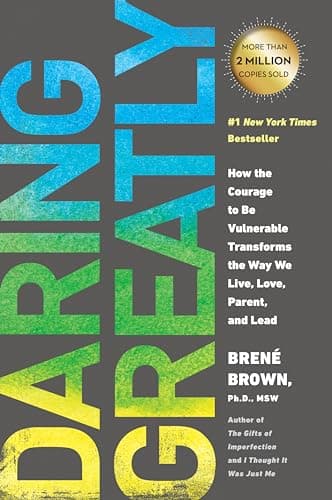
Daring Greatly
Brené Brown on how the courage to be vulnerable transforms how we live and lead.
Why We Recommend This
- 1
Brené Brown's bestseller on vulnerability and courage
- 2
Argues vulnerability is the birthplace of connection and joy
- 3
Confronts shame and the armor we use to hide
- 4
Research-based, deeply human, and warmly written
- 5
Reframes courage as showing up when you can't control outcomes
- 6
Resonates with the call to live authentically and openly
Opens Amazon in a new tab. Prices may vary.
Our Full Review
"Daring greatly" means showing up and being seen — even when there are no guarantees.
What Is This Book Really About?
In Daring Greatly, researcher and storyteller Brené Brown makes a counterintuitive case: vulnerability — the very thing we work so hard to avoid — is actually the path to courage, connection, and a wholehearted life. Drawing on years of research into shame and human connection, she argues that the willingness to be seen, without armor and without guarantees, is not weakness but daring.
The title comes from a famous speech about the person "in the arena" — the one whose face is marred by dust and sweat, who dares greatly and risks failing rather than standing safely on the sidelines. Brown uses this image to challenge our culture's obsession with appearing invulnerable, productive, and put-together. That armor, she argues, doesn't protect us; it isolates us.
For a faith reader, much of this rings true. We are made for connection, called to honesty and humility, and reminded that perfect love casts out fear. Brown gives research-grounded language to a deeply human — and deeply scriptural — longing: to be fully known and still belong. Few of us were taught that vulnerability could be a strength; most of us learned the opposite, and learned it well.
The Core Ideas
1. Vulnerability as Courage
Brown redefines vulnerability not as weakness but as the brave act of showing up when the outcome isn't in our control.
2. Shame vs. Guilt
She distinguishes shame ("I am bad") from guilt ("I did something bad"), showing how shame corrodes us while honest accountability heals.
3. Letting Go of Armor
We protect ourselves with perfectionism, numbing, and cynicism. Brown invites us to set the armor down and live more openly.
4. Wholehearted Living
The goal isn't fearlessness but engagement — daring to love, create, and connect despite the risk of being hurt. Brown is clear that courage and comfort rarely coexist; the wholehearted life is one that chooses to show up anyway.
5. The Myths That Hold Us Back
Brown also gently dismantles the stories we tell ourselves about vulnerability — that it's weakness, that we can opt out of it, that it means oversharing. She reframes each one, showing that vulnerability isn't winning or losing but having the courage to be seen when we can't control the outcome. For leaders, parents, and creators especially, this reframing reshapes how we engage with risk itself.
Why This Book Works
It names shame out loud. Brown talks plainly about something most of us carry in silence, and the naming itself brings relief. So much of shame's power comes from secrecy, and simply hearing it described accurately begins to loosen its grip.
It's research-grounded and human. Her data gives weight to ideas that could feel soft, while her storytelling keeps them warm.
It reframes strength. Showing up and being seen becomes the brave thing — a freeing redefinition for anyone exhausted by pretending.
Who Should Read This Book
- You if you wear yourself out trying to appear strong and put-together.
- You if shame quietly runs more of your life than you'd like to admit.
- You if you long for deeper connection but keep your guard up.
- You if you lead, parent, or create and want to do it more wholeheartedly.
What We Love About It
- Shame-naming courage: It speaks the unspoken and loosens its grip.
- Warmly research-based: Rigorous and deeply human at once.
- Connection-focused: It points us back toward one another.
- Freeing reframe: Vulnerability becomes strength, not weakness.
Our Verdict
Daring Greatly struck a chord with millions of readers, and it's easy to see why: Brown gives us permission to stop performing and start living honestly. Her central insight — that vulnerability is the birthplace of connection — is both well-researched and quietly true to experience.
Perfect love casts out fear.
For believers, much of this resonates beautifully with the call to live authentically, to confess rather than hide, and to find our courage not in self-sufficiency but in love. We are people who believe we are fully known and still fully loved — and that truth is the deepest ground for the kind of openness Brown describes. While she writes from a research rather than a faith perspective, her work can deepen how we understand shame, honesty, and the freedom of being seen as we really are.
If you're tired of the exhausting work of appearing invulnerable — of managing an image, numbing what hurts, and keeping everyone at arm's length — this book is a warm, wise invitation to dare greatly instead. It won't promise you safety; it will promise you that the risk of being seen is worth it. We recommend it gladly to anyone ready to set down the armor and step into the arena.
Daring Greatly
18,000 reviews on Amazon
Same Category