As an Amazon Associate, we earn from qualifying purchases.
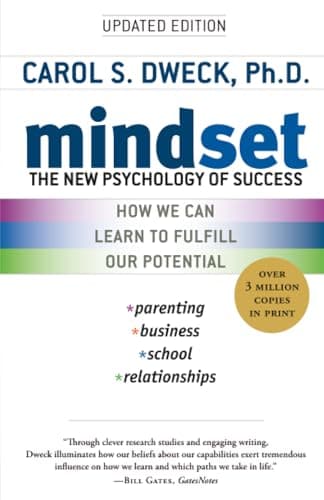
Mindset: The New Psychology of Success
Carol Dweck's research on the growth mindset and how beliefs shape achievement.
Why We Recommend This
- 1
Stanford psychologist Carol Dweck's influential mindset research
- 2
Contrasts a fixed mindset with a growth mindset
- 3
Shows how beliefs about ability shape effort and outcomes
- 4
Reframes failure as feedback, not a verdict
- 5
Transforms how we parent, teach, lead, and learn
- 6
Aligns with grace: we are works in progress
Opens Amazon in a new tab. Prices may vary.
Our Full Review
What you believe about your own potential may matter more than the potential itself.
What Is This Book Really About?
In Mindset, Stanford psychologist Carol Dweck presents one of the most widely discussed ideas in modern psychology: the difference between a "fixed" mindset and a "growth" mindset. Drawing on decades of research, she argues that the beliefs we hold about our own abilities quietly shape almost everything — how we handle challenges, how we respond to failure, and ultimately how much we grow.
A fixed mindset assumes that talent and intelligence are set in stone — you either have it or you don't. A growth mindset, by contrast, sees ability as something that develops through effort, learning, and persistence. The two postures lead to dramatically different lives. Where the fixed mindset avoids challenges to protect its image, the growth mindset leans into them as opportunities to improve.
For a faith reader, there's something quietly resonant here. We are people who believe in transformation — that no one is finished, that growth is possible, and that our worth doesn't hang on a single performance.
The Two Mindsets in Action
1. How We Face Challenges
A fixed mindset sees a hard task as a threat to its self-image; a growth mindset sees the same task as a chance to stretch and learn.
2. How We Handle Failure
For the fixed mindset, failure is a label — "I'm not good at this." For the growth mindset, it's feedback — "I'm not good at this yet."
3. How We Hear Criticism
Dweck shows how a growth mindset receives correction as useful rather than wounding — a posture that serves humility and learning alike.
4. How We Raise and Lead Others
Praising effort and strategy, rather than fixed traits, helps children and teams develop resilience instead of fragility. Dweck's research suggests that telling a child "you're so smart" can quietly backfire — teaching them to protect the label rather than risk the struggle that real learning requires.
5. Mindsets Are Not Fixed
Crucially, Dweck argues that no one is purely one mindset or the other, and that we can shift toward growth with awareness and practice. We tend to slip into a fixed mindset in the areas where we feel most exposed. Naming those triggers — and choosing to add "yet" — is itself a learnable skill, which keeps the book from becoming just another fixed label of its own.
Why This Book Works
It reframes failure. That one little word — yet — changes how you face every setback, turning dead ends into doorways. It's a small linguistic shift with an outsized effect on how we persevere.
It's research-grounded. Dweck draws on substantial study, so the ideas carry weight beyond mere encouragement.
It applies everywhere. Parenting, marriage, work, faith, fitness — the mindset distinction shows up in all of it.
Who Should Read This Book
- You if you avoid challenges out of fear of looking incapable.
- You if a single failure can convince you to give up entirely.
- You if you parent, teach, coach, or lead and want to nurture resilience.
- You if you believe people can change and want language for how.
What We Love About It
- The power of "yet": A small word that reshapes your whole posture.
- Research-backed: Grounded in real study, not just slogans.
- Broadly useful: It touches nearly every area of life.
- Hopeful: It insists you are not stuck — you can grow.
Our Verdict
Mindset has rightly become a modern classic, and its core idea is both simple and life-altering: the way you think about your ability shapes what you become. Dweck offers not a pep talk but a research-grounded invitation to see yourself — and others — as capable of real change.
Not that I have already obtained this... but I press on.
For believers, this lands close to home. We are, by grace, works in progress — called to keep growing, to receive correction with humility, and to refuse the lie that we are finished or stuck in who we've always been. Dweck's framework gives practical, everyday language to that hope, and a vocabulary you can hand to your children, your students, or your team.
There's a caution worth naming gently: a growth mindset is a wonderful tool, but it isn't a savior. Our deepest growth comes not from sheer effort but from grace working in us over time. Held in that light, though, Dweck's research is a genuine gift. Whether you want to grow yourself or help others flourish, this book will change how you think about effort, failure, and potential — and that word yet may quietly reshape how you talk to yourself for years to come. We recommend it heartily.
Mindset: The New Psychology of Success
30,000 reviews on Amazon
Same Category