As an Amazon Associate, we earn from qualifying purchases.
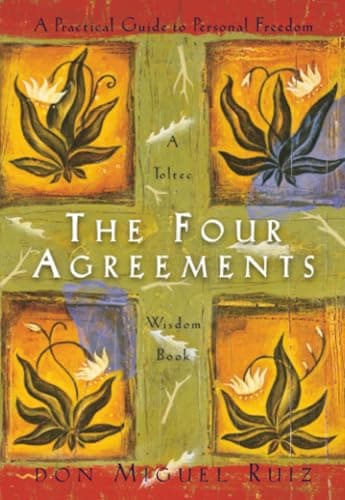
The Four Agreements
Don Miguel Ruiz's Toltec wisdom — four simple agreements for personal freedom.
Why We Recommend This
- 1
A short, popular guide to four simple life principles
- 2
Rooted in ancient Toltec wisdom, not Christian theology
- 3
"Be impeccable with your word" reframes how you speak
- 4
Practical tools for less self-judgment and reactivity
- 5
Read with discernment: take the wisdom, keep your faith
- 6
Best paired with a clear biblical understanding of truth
Opens Amazon in a new tab. Prices may vary.
Our Full Review
A widely loved little book — best read with an open mind and a discerning heart.
What Is This Book Really About?
The Four Agreements by Don Miguel Ruiz distills what the author presents as ancient Toltec wisdom into four simple commitments meant to free us from self-defeating beliefs. It has sold many millions of copies and remains a fixture on self-help shelves for one reason: the four agreements are short, memorable, and genuinely useful as everyday practices.
We want to be honest up front. This is not a Christian book. Its spiritual framework comes from a Toltec tradition, and Ruiz speaks of human beings in ways a Bible reader will want to weigh carefully. As believers, our truth is grounded in God and His Word, not in self-derived enlightenment. So we read a book like this the way Scripture invites us to — testing everything and holding fast to what is good.
With that posture, there's real value here. Much of what Ruiz describes overlaps with hard-won wisdom about the tongue, judgment, and the stories we tell ourselves.
The Four Agreements
1. Be Impeccable With Your Word
Speak with integrity; say only what you mean; avoid using words against yourself or others. This echoes the biblical seriousness about the power of the tongue.
2. Don't Take Anything Personally
Others' actions usually reveal more about them than about you. A faith reader can hear in this an invitation to release offense and entrust judgment to God.
3. Don't Make Assumptions
Ask questions; communicate clearly; don't build resentment on guesses. Practical wisdom for any marriage, friendship, or workplace.
4. Always Do Your Best
Your best varies day to day — and that's okay. Faithfulness over perfectionism is a deeply healthy reframe, and one that lines up surprisingly well with a grace-shaped understanding of effort: we offer what we can, and we trust God with the rest.
A Note on the Framework
It's worth saying again that the agreements arrive wrapped in a spiritual worldview that isn't Christian. Ruiz speaks of human beings as their own source of liberation and frames belief itself as something to be dismantled. A faith reader will simply want to keep that in view — receiving the practical commitments while not adopting the metaphysics underneath them. The agreements work as habits of love and humility; they falter as a theology.
Why This Book Works
It's memorable. Four short rules you can actually recall and apply mid-argument or mid-spiral. Most self-help advice evaporates by the next morning; these four stick because they're so few.
It targets self-talk. Much of our anxiety comes from the inner voice — the running commentary of judgment and assumption — and this book confronts it directly and gently. For anyone whose harshest critic is themselves, that focus is genuinely useful.
It's short and accessible. You can read it in an afternoon and start practicing immediately. There's no jargon, no long program, just four commitments you can begin living before you've even finished the book.
Who Should Read This Book
- You if you struggle with people-pleasing or taking everything to heart.
- You if your inner critic is loud and you want practical tools to quiet it.
- You if you enjoy distilling big ideas into a few daily disciplines.
- You if you can read across worldviews without losing your footing.
What We Love About It
- Compact wisdom: Four agreements, easy to remember, hard to master.
- Tongue-focused: The first agreement alone is worth the price.
- Anti-anxiety: It loosens the grip of others' opinions.
- Actionable today: No long program — just commitments you can live now.
Our Verdict
For a faith reader, The Four Agreements is best approached as a tool, not a teacher. Its underlying spirituality isn't ours, and we'd gently encourage you to keep your Bible as your anchor while you read. Where Ruiz speaks of self-rescue, we remember that our freedom is a gift of grace, not a self-help achievement.
Test everything; hold fast to what is good.
That said, the four practical commitments — watch your words, don't take offense, don't assume, do your best — are sturdy, sane, and surprisingly aligned with biblical wisdom about humility and the tongue. The book's brevity is part of its gift: there's nothing here you can't begin practicing the same day you read it, and the four agreements are short enough to actually remember in the heat of a hard conversation.
Read it with discernment, take the genuinely useful parts, and let the rest go. For a reader who is spiritually anchored, it can be a helpful, lightweight tool for becoming more intentional with words and less captive to others' opinions. For a reader looking for spiritual truth, we'd point you back to Scripture first. Engaged wisely, it can sharpen how you speak and ease how you carry the weight of what others think.
The Four Agreements
80,000 reviews on Amazon
Same Category