As an Amazon Associate, we earn from qualifying purchases.
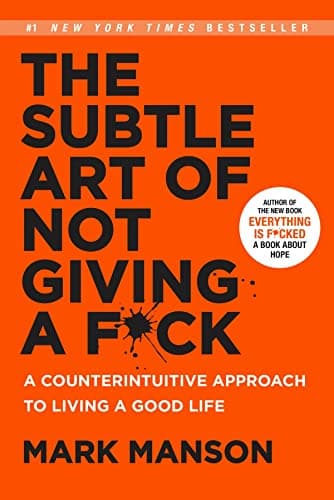
The Subtle Art of Not Giving a F*ck
Mark Manson's counterintuitive guide to living a good life by caring about less, but better.
Why We Recommend This
- 1
A blunt, bestselling counter to feel-good self-help
- 2
Core idea: choose your values, and care only about what matters
- 3
Accepting limits and struggle as the path to a meaningful life
- 4
Irreverent humor and frank language throughout — be aware
- 5
A useful nudge toward intentional priorities and honesty
- 6
Best read with discernment by faith-minded readers
Opens Amazon in a new tab. Prices may vary.
Our Full Review
A deliberately provocative title with a surprisingly old idea underneath. Mark Manson's The Subtle Art of Not Giving a F*ck became a runaway bestseller by pushing back hard against the relentless positivity of much self-help. We'll be candid up front: this is a secular book with frequent profanity — but it carries one genuinely useful idea for the discerning reader.
What Is This Book Really About?
Despite the irreverent title, Manson's central argument is fairly classical: you have a limited amount of attention and energy, so you must choose carefully what you'll actually invest yourself in. Caring about everything leaves you anxious and scattered; caring deeply about a few right things gives life focus.
Manson also pushes back against the cultural pressure to feel positive all the time. He argues that struggle, limitation, and even pain are unavoidable — and that a good life comes not from avoiding problems but from choosing problems worth having.
For the faith reader, the most valuable thread here is what amounts to values clarification: deciding what truly matters and refusing to be ruled by everything else. That instinct echoes the call to seek first what is most important and hold the rest loosely. The packaging is crude; the kernel is worth keeping.
Manson writes in a blunt, conversational, deliberately profane style that has clearly struck a nerve with readers tired of polished motivational platitudes. His irreverence is part of his appeal and part of the point — he's trying to puncture self-help clichés rather than add to them. A faith reader should go in with eyes open: this is not a gentle book, and its tone will not be for everyone.
The Core Ideas
Choose Your Values Wisely
Manson argues that everyone cares about something — the question is whether you've chosen good values or absorbed shallow ones by default. Examining what you build your life around is genuinely worthwhile reflection.
Embrace Struggle and Limitation
Rather than chasing a frictionless life, Manson says to accept that meaningful things require hardship. Choose the struggles worth your effort, and stop expecting a problem-free existence.
Take Radical Responsibility
Manson insists you're responsible for how you respond to your circumstances, even ones you didn't cause. Read charitably, it's a call to ownership and maturity.
Why This Book Works
It punctures false expectations. Manson is honest that life involves suffering and that endless positivity is a trap — a corrective many readers find freeing.
It forces prioritization. The book pushes you to decide what genuinely deserves your care, which can be clarifying for an overcommitted, anxious mind.
It's disarmingly readable. Manson's blunt humor keeps the pages turning, even as he smuggles in some fairly serious philosophy.
Who Should Read This Book
- You if you feel pulled in a hundred directions and need to clarify your priorities
- You if you're worn out by toxic positivity and want a more honest framing of struggle
- You if you can read past frequent profanity to find the useful core idea
- You if you want a values-examination prompt, read alongside your own faith convictions
What We Love About It
- Honest about struggle: It refuses the empty promise that life can be problem-free.
- Clarifying questions: Its push to choose your values can be genuinely helpful.
- Brisk and engaging: It's an easy, often funny read despite tackling heavy themes.
- A jumping-off point: The values question it raises is one faith offers far richer answers to.
- Countercultural honesty: Its willingness to name life's limits is a needed corrective to hype.
- Practical focus: It pushes you toward fewer, deeper commitments rather than scattered effort.
Our Verdict
Let's be straightforward. This is a secular book, the language is frequently coarse, and Manson's worldview is not a faith-based one — at points it leans on a self-defined morality that a believer will gently disagree with. If profanity bothers you, this may not be the book for you, and that's perfectly fine.
That said, read with discernment, its central idea has real merit. The call to choose your values deliberately, to stop caring about everything, and to accept that meaningful life involves struggle — these are instincts a faith reader can affirm and, frankly, answer more deeply. Where Manson says "choose your values," the believer already has a foundation to build on.
The desire for more positive experience is itself a negative experience.
It's worth noting, too, that the book is more thoughtful than its shock-value title suggests. Beneath the bravado, Manson is wrestling with genuinely serious questions — about mortality, responsibility, and what makes a life well spent. He simply arrives at answers that are incomplete from a faith perspective, gesturing toward meaning without naming its true source. That gap is exactly where a believing reader can engage most fruitfully.
Our honest recommendation: approach this one as a conversation partner, not a guide. Take the helpful question it raises about priorities, hold it up against your own deeper convictions, and let your faith fill in the answers Manson leaves open.
The Subtle Art of Not Giving a F*ck
120,000 reviews on Amazon
Same Category