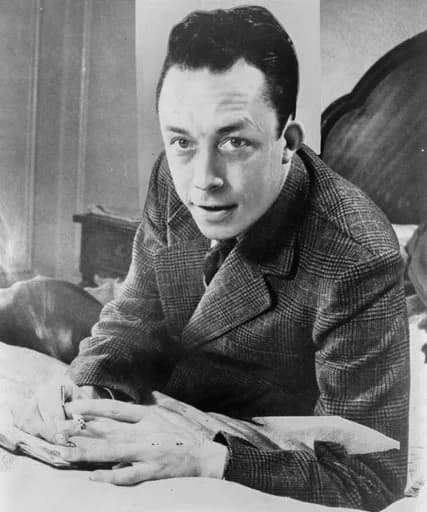
Albert Camus
1913 – 1960
About Albert Camus
Albert Camus (1913–1960) was a French-Algerian novelist, playwright, essayist, and philosopher who received the Nobel Prize in Literature in 1957. Born in poverty in colonial Algeria to a French father who died in World War I before Camus could know him, he was raised by an illiterate mother in Algiers. His major works — The Stranger (1942), The Myth of Sisyphus (1942), The Plague (1947), and The Rebel (1951) — articulate his philosophy of the Absurd: the confrontation between human desire for meaning and the universe's silence.
He died in a car accident at 46, at the height of his powers.
“Blessed are the hearts that can bend; they shall never be broken.”
Quick Facts
- Born
- 1913
- Died
- 1960
- Lifespan
- 47 years
- Domain
- inspiration
- Quotes
- 5 collected
- Key Themes
- FlexibilityResilienceHappinessFreedomPerspective
Learn More
Wikipedia — Albert CamusAlbert Camus's Famous Quotes
5 quotes
“Blessed are the hearts that can bend; they shall never be broken.”
— Widely attributed to Camus; exact source unverified in his documented works
“In the depth of winter, I finally learned that within me there lay an invincible summer.”
— "Return to Tipasa" — collected in Summer (L'Été, 1954)
“You will never be happy if you continue to search for what happiness consists of. You will never live if you are looking for the meaning of life.”
— Notebooks 1935–1942 (Carnets, published 1962)
“The only way to deal with an unfree world is to become so absolutely free that your very existence is an act of rebellion.”
— Widely attributed to Camus; not conclusively traced to a specific primary source — consistent with themes in The Myth of Sisyphus (1942)
“Autumn is a second spring when every leaf is a flower.”
— Widely attributed to Camus — consistent with his lyrical essays; possibly from American Journals (1978)
Explore Related Content
Articles and guides inspired by inspiration thinkers like Albert Camus
Failure Is Not the Opposite of Success — It Is Information
Treating failure as a verdict rather than a data point is the single most common reason intelligent people stop short of becoming good at the things they care about most. The opposite of success is not failure. It is ignorance.
Read article →
Work-Life Balance Is a Myth. Here's What Actually Works.
Balance implies two equal sides held in static equilibrium. Most adult lives are not built this way. The actual problem is not imbalance — it is treating recovery as optional and integration as impossible.
Read article →
Marcus Aurelius Never Planned to Be Emperor — and That Made Him Great
Marcus Aurelius did not want to be emperor. He wrote Meditations as private notes to himself, never intending publication. The most-quoted Stoic text in history is a man arguing with his own weakness in the dark — and that is why it still works.
Read article →
More inspiration
Browse all authors →Arundhati Roy
Arundhati Roy (born 1961) is an Indian author and activist whose debut novel *The God of Small Things* (1997) won the Booker Prize and sold more than eight million copies worldwide, making it one of the best-selling novels ever by a non-expatriate Indian author. Born in Shillong and raised in Kerala, Roy trained as an architect before writing her debut. After its success, she turned primarily to political essays — opposing nuclear testing, the Narmada Dam displacement, and the U.S. invasions of Afghanistan and Iraq — collected in *The Algebra of Infinite Justice* (2002) and *Listening to Grasshoppers* (2009). Her second novel, *The Ministry of Utmost Happiness* (2017), arrived twenty years after her first. She remains one of India's most fearless public intellectuals.

Mo Yan
Mo Yan (born 1955) is a Chinese author who received the Nobel Prize in Literature in 2012, cited for his "hallucinatory realism" that "merges folk tales, history and the contemporary." Born Guan Moye in Gaomi, Shandong — a rural area that becomes the setting of much of his fiction — he left school during the Cultural Revolution to work in the fields, then served in the People's Liberation Army. His international reputation was established by *Red Sorghum* (1987), a visceral novel of wartime Shandong that was adapted into a Zhang Yimou film. His subsequent novels — *The Republic of Wine* (1992), *Big Breasts and Wide Hips* (1995), and *Life and Death Are Wearing Me Out* (2006) — blend Chinese folklore, Rabelaisian excess, and political critique. The Nobel Prize generated controversy because of his silence on the imprisonment of Liu Xiaobo, but he remains the most internationally recognized Chinese author.

Eckhart Tolle
Eckhart Tolle is a renowned spiritual teacher and author, best known for his books "The Power of Now" and "A New Earth." His teachings focus on the importance of presence, mindfulness, and awakening to one's true self. Tolle's work has inspired millions to live more consciously and find peace in the present moment.

Maya Angelou
Maya Angelou (1928–2014) was an American poet, memoirist, and civil rights activist whose seven-volume autobiography, beginning with I Know Why the Caged Bird Sings (1969), transformed American literature. Born Marguerite Annie Johnson in St. Louis, Missouri, she endured a childhood marked by racial segregation, sexual trauma, and years of voluntary muteness. She became a dancer, singer, actress, journalist, playwright, and eventually one of the most celebrated poets in American history. In 1993 she delivered her poem "On the Pulse of Morning" at President Bill Clinton's inauguration. She received the Presidential Medal of Freedom in 2011. Her work is inseparable from the Civil Rights Movement — she was a close friend and collaborator of both Malcolm X and Martin Luther King Jr.
Frequently Asked Questions
Albert Camus (1913–1960) was a French-Algerian novelist, playwright, essayist, and philosopher who received the Nobel Prize in Literature in 1957. Born in poverty in colonial Algeria to a French father who died in World War I before Camus could know him, he was raised by an illiterate mother in Algiers. His major works — The Stranger (1942), The Myth of Sisyphus (1942), The Plague (1947), and The Rebel (1951) — articulate his philosophy of the Absurd: the confrontation between human desire for meaning and the universe's silence. He died in a car accident at 46, at the height of his powers. The Nobel committee praised him for illuminating "the problems of the human conscience in our times." Albert Camus lived 1913 – 1960.