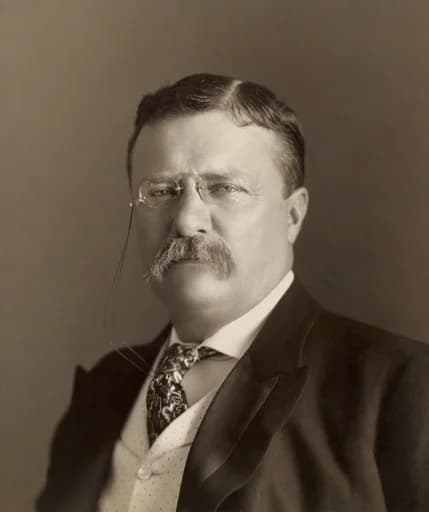
Speak softly and carry a big stick; you will go far.
Biography
About Theodore Roosevelt
Theodore Roosevelt (1858–1919) was the 26th President of the United States (1901–1909), the youngest person to hold the office. Born into a wealthy New York family with severe asthma, he rebuilt his health through rigorous physical effort — a practice that became a lifelong philosophy. As president, he broke up major corporate trusts, established the national park system (over 230 million acres), won the Nobel Peace Prize for mediating the Russo-Japanese War (1906), and launched the Panama Canal.
He was also a prolific author (over 35 books) and naturalist. After leaving office, he ran unsuccessfully as a third-party candidate in 1912, surviving an assassination attempt mid-campaign. He is consistently ranked among the greatest US presidents in historical surveys.
Key Themes
Quick Facts
- Born
- 1858
- Died
- 1919
- Lifespan
- 61 yrs
- Quotes
- 4 collected
Wisdom
Theodore Roosevelt's Famous Quotes
“Speak softly and carry a big stick; you will go far.”
— Letter to Henry L. Sprague, 1900
Roosevelt used this West African proverb in a letter well before his presidency, as a statement of his foreign policy philosophy: negotiate from a position of quiet strength rather than loud threat. His administration would later use this phrase to describe his approach to international diplomacy — winning significant outcomes through backstage negotiation while maintaining a visible deterrent. He avoided declaring war during the Russo-Japanese War negotiations (1904–05) that won him the Nobel Peace Prize.
“It is hard to fail, but it is worse never to have tried to succeed.”
— The Strenuous Life (speech), 1899
Roosevelt''s "Strenuous Life" speech was a manifesto of active engagement against the emerging culture of comfortable withdrawal from civic and physical challenge. He addressed the American upper class specifically, arguing that wealth without effort, leisure without purpose, and safety at the expense of principle were forms of national decay. The speech remains one of his most quoted addresses.
“Keep your eyes on the stars, and your feet on the ground.”
— Address at the Groton School, 1904
Roosevelt lived this balance personally. As a child he was sickly and asthmatic; he became an outdoorsman, boxer, cavalry officer, and rancher through deliberate effort. As president, he pursued conservation of the natural world (the stars) while staying deeply engaged in the messy daily politics of governance (the ground). The image captures his version of pragmatic idealism: ambitious vision paired with immediate practical engagement.
“Far and away the best prize that life has to offer is the chance to work hard at work worth doing.”
— A Square Deal (Labor Day address), 1903
Roosevelt delivered this as part of a speech on labor, arguing that all honest work has dignity and that meaningful work is its own reward. He himself was a living demonstration: despite being a wealthy patrician, he sought out physically demanding work — cattle ranching in Dakota, military service in Cuba — not for necessity but because he believed that work worthy of serious effort was the best the world offered.
From the Blog
Related Reading
Discover
More Thought Leaders
Need to Know
Frequently Asked Questions
Theodore Roosevelt (1858–1919) was the 26th President of the United States (1901–1909), the youngest person to hold the office. Born into a wealthy New York family with severe asthma, he rebuilt his health through rigorous physical effort — a practice that became a lifelong philosophy. As president, he broke up major corporate trusts, established the national park system (over 230 million acres), won the Nobel Peace Prize for mediating the Russo-Japanese War (1906), and launched the Panama Canal. He was also a prolific author (over 35 books) and naturalist. After leaving office, he ran unsuccessfully as a third-party candidate in 1912, surviving an assassination attempt mid-campaign. He is consistently ranked among the greatest US presidents in historical surveys. Theodore Roosevelt lived 1858 – 1919.
Morning Practice
Continue Your Daily Reflection
Daily faith-based affirmations and quotes from inspiring thinkers like Theodore Roosevelt.
Free access. New quotes & reflections every day.