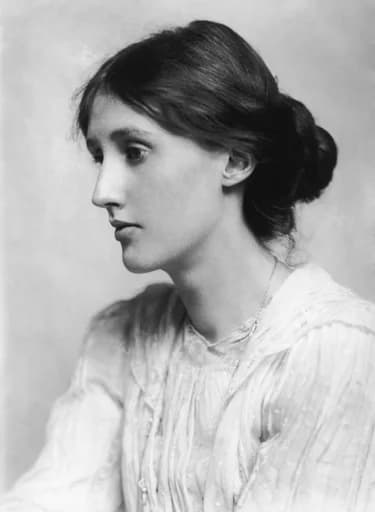
Lock up your libraries if you like; but there is no gate, no lock, no bolt that you can set upon the freedom of my mind.
Biography
About Virginia Woolf
Virginia Woolf (1882–1941) was an English novelist and essayist, one of the foremost modernist writers and a pioneering figure in feminist literary criticism. S. Eliot, Sigmund Freud, and Katherine Mansfield.
Her major novels — Mrs Dalloway (1925), To the Lighthouse (1927), and The Waves (1931) — advanced stream-of-consciousness as a literary form capable of capturing the full texture of inner life. Her essays A Room of One's Own (1929) and Three Guineas (1938) remain foundational texts of feminist thought. She died by suicide in 1941, walking into the River Ouse near her home.
Key Themes
Quick Facts
- Born
- 1882
- Died
- 1941
- Lifespan
- 59 yrs
- Quotes
- 3 collected
Wisdom
Virginia Woolf's Famous Quotes
“Lock up your libraries if you like; but there is no gate, no lock, no bolt that you can set upon the freedom of my mind.”
Woolf directed this at the college officials who had excluded her from the library at Oxbridge (a composite of Oxford and Cambridge). The sentence is a declaration of intellectual sovereignty: physical access and institutional permission can be denied, but the act of thinking cannot be policed. She wrote the essay in 1929, when women had only recently won the vote in Britain — making the distinction between physical and mental freedom immediately political.
“The eyes of others our prisons; their thoughts our cages.”
Woolf was acutely attuned to the way social judgment — the constant awareness of how one appears to others — constrains interior life. Her entire stream-of-consciousness technique in Mrs Dalloway and The Waves is partly an attempt to create literary spaces where consciousness unfolds free from external evaluation. The image of "eyes as prisons" applies both to social convention and to the internalized self-criticism that prevents authentic thought.
“One cannot think well, love well, sleep well, if one has not dined well.”
Woolf said this in A Room of One''s Own during lunch at a men''s college, where she contrasted the elaborate meal she was served with the plain food at the women''s college she visited afterward. The point is not merely about food — it is that material conditions (good food, a room of one''s own, financial independence) produce the mental states that make genuine thought possible. Creativity is not purely a matter of will; it requires physical conditions.
From the Blog
Related Reading
Discover
More Thought Leaders
Need to Know
Frequently Asked Questions
Virginia Woolf (1882–1941) was an English novelist and essayist, one of the foremost modernist writers and a pioneering figure in feminist literary criticism. Born into a privileged London intellectual family, she co-founded the Hogarth Press with her husband Leonard Woolf, which published her own work and that of T.S. Eliot, Sigmund Freud, and Katherine Mansfield. Her major novels — Mrs Dalloway (1925), To the Lighthouse (1927), and The Waves (1931) — advanced stream-of-consciousness as a literary form capable of capturing the full texture of inner life. Her essays A Room of One's Own (1929) and Three Guineas (1938) remain foundational texts of feminist thought. She died by suicide in 1941, walking into the River Ouse near her home. Virginia Woolf lived 1882 – 1941.
Morning Practice
Continue Your Daily Reflection
Daily faith-based affirmations and quotes from inspiring thinkers like Virginia Woolf.
Free access. New quotes & reflections every day.