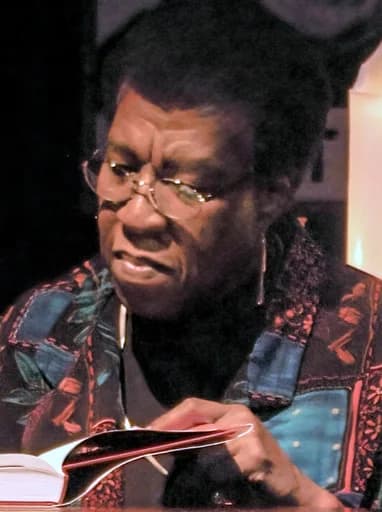
When your rage is choking you, it is best to say nothing.
Biography
About Octavia E. Butler
Octavia E. Butler (1947–2006) was an American science fiction author and the first science fiction writer to receive a MacArthur Foundation "genius" fellowship (1995). Born in Pasadena, California, she began writing science fiction at age 10 and published her debut novel Patternmaster in 1976.
She is best known for the Parable series (Parable of the Sower, 1993; Parable of the Talents, 1998), the standalone novel Kindred (1979), and the Patternist series. Her fiction is distinguished by its unflinching engagement with power, biology, race, gender, and the ethics of survival — she was doing "Afrofuturism" decades before the term existed. She received two Hugo Awards, two Nebula Awards, and a Locus Award.
She died suddenly from a stroke at 58, leaving the Parable series unfinished.
Key Themes
Wisdom
Octavia E. Butler's Famous Quotes
“When your rage is choking you, it is best to say nothing.”
Butler said various versions of this in interviews about her writing practice. She wrote science fiction featuring Black women protagonists at a time when both were systematically excluded from the genre, and she did so by choosing disciplined silence — not engaging with the gatekeepers who dismissed her, but consistently producing the work. The instruction is a practical tool for anyone whose anger, however justified, is consuming the energy needed for creation.
“The only lasting truth is Change.”
"God is Change" is the central tenet of Earthseed — Butler''s fictional religion — which grounds this assertion. The capital C in "Change" signals that Butler is treating it as the fundamental reality rather than one feature among others. This is influenced by her reading of thermodynamics and evolutionary biology: from her perspective, the only reliable thing about existence is its flux. Working with change rather than against it is, in Earthseed, the definition of wisdom.
“All that you touch you change. All that you change changes you.”
Butler embedded this as one of the foundational verses of Earthseed, the fictional religion developed by her protagonist Lauren Olamina in a near-future collapsed California. The verse operates as both ecological observation and spiritual principle: interaction is transformative in both directions. Butler was deeply interested in the biology of symbiosis and parasitism, and Earthseed translates that into human ethics — engagement always leaves both parties changed.
From the Blog
Related Reading
Discover
More Thought Leaders
Need to Know
Frequently Asked Questions
Octavia E. Butler (1947–2006) was an American science fiction author and the first science fiction writer to receive a MacArthur Foundation "genius" fellowship (1995). Born in Pasadena, California, she began writing science fiction at age 10 and published her debut novel Patternmaster in 1976. She is best known for the Parable series (Parable of the Sower, 1993; Parable of the Talents, 1998), the standalone novel Kindred (1979), and the Patternist series. Her fiction is distinguished by its unflinching engagement with power, biology, race, gender, and the ethics of survival — she was doing "Afrofuturism" decades before the term existed. She received two Hugo Awards, two Nebula Awards, and a Locus Award. She died suddenly from a stroke at 58, leaving the Parable series unfinished. Octavia E. Butler lived 1947 – 2006.
Morning Practice
Continue Your Daily Reflection
Daily faith-based affirmations and quotes from inspiring thinkers like Octavia E. Butler.
Free access. New quotes & reflections every day.