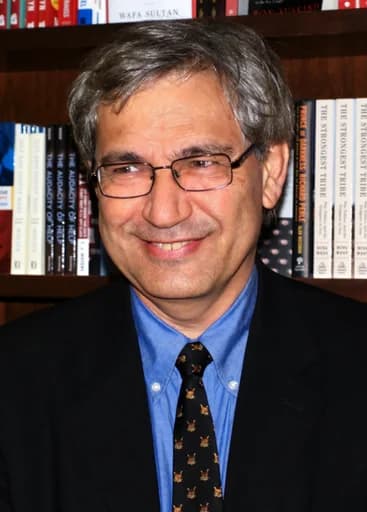
Real museums are places where Time is transformed into Space.
Biography
About Orhan Pamuk
" Born in Istanbul to a wealthy Westernized family, he studied architecture before dedicating himself to writing. His novels — including *The White Castle* (1985), *The Black Book* (1990), *My Name Is Red* (1998), and *Snow* (2002) — are steeped in Ottoman history, Istanbul's layered geography, and the tension between tradition and modernity. In 2005 he was prosecuted under Article 301 of the Turkish Penal Code for publicly acknowledging the Armenian genocide.
His memoir *Istanbul: Memories and the City* (2003) and novel *The Museum of Innocence* (2008) — which he accompanied with an actual museum in Istanbul — show his deepening engagement with the city as subject.
Key Themes
Wisdom
Orhan Pamuk's Famous Quotes
“Real museums are places where Time is transformed into Space.”
— The Museum of Innocence, 2008
Pamuk's novel about obsessive love in 1970s Istanbul is built around a museum the narrator constructs to house objects associated with his lost beloved — effectively converting time into physical space. The quote is the novel's thesis: that a museum is not merely a collection of things but a technology for making the past inhabitable. Pamuk later built a real Museum of Innocence in Istanbul to accompany the book.
“The silence of snow, thought the man sitting just behind the bus driver.”
In Pamuk's political novel set in the snowbound Anatolian city of Kars — where soldiers, Islamists, secularists, and artists collide during a blizzard — silence itself becomes charged with political and emotional meaning. Snow muffles sound and isolates the city; its silence is the silence of things about to break. Pamuk uses the unnamed bus driver's thought to ground the novel's political violence in sensory, intimate experience.
“Life can't be all that bad, I'd think from time to time. Whatever happens, I can always take a long walk along the Bosphorus.”
— Istanbul: Memories and the City, 2003
From Pamuk's memoir about growing up in Istanbul, this line captures the city as emotional sustaining force — not a setting but a remedy. He describes walking along the Bosphorus as his particular form of self-restoration after difficulty. Istanbul for Pamuk is not beautiful despite its melancholy (*hüzün*) but because of it — the city's ruins, its failing empires, its fog are inseparable from its capacity to console.
“Happiness is holding someone in your arms and knowing you hold the whole world.”
This line — spoken by Kemal, the narrator, at the moment he first holds Füsun — is one of the most direct expressions of Pamuk's central preoccupation: that love for another person contains love for an entire world. Istanbul itself, for Pamuk, is such a beloved: to know a city this intimately is to hold its whole civilization in your arms. He received the Nobel Prize in 2006 "in the quest for the melancholic soul of his native city."
From the Blog
Related Reading
Discover
More Thought Leaders
Need to Know
Frequently Asked Questions
Orhan Pamuk (born 1952) is a Turkish novelist who received the Nobel Prize in Literature in 2006, cited by the Swedish Academy for "in the quest for the melancholic soul of his native city, has discovered new symbols for the clash and interlacing of cultures." Born in Istanbul to a wealthy Westernized family, he studied architecture before dedicating himself to writing. His novels — including *The White Castle* (1985), *The Black Book* (1990), *My Name Is Red* (1998), and *Snow* (2002) — are steeped in Ottoman history, Istanbul's layered geography, and the tension between tradition and modernity. In 2005 he was prosecuted under Article 301 of the Turkish Penal Code for publicly acknowledging the Armenian genocide. His memoir *Istanbul: Memories and the City* (2003) and novel *The Museum of Innocence* (2008) — which he accompanied with an actual museum in Istanbul — show his deepening engagement with the city as subject. Orhan Pamuk lived b. 1952.
Morning Practice
Continue Your Daily Reflection
Daily faith-based affirmations and quotes from inspiring thinkers like Orhan Pamuk.
Free access. New quotes & reflections every day.