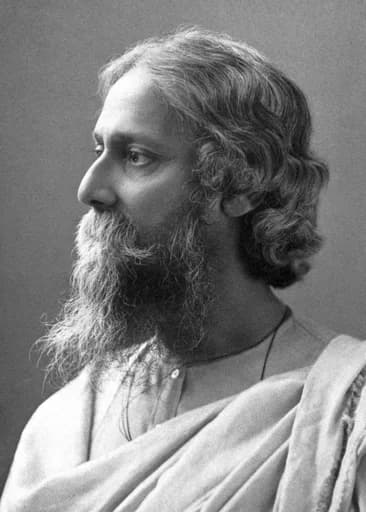
Rabindranath Tagore
Let your life lightly dance on the edges of Time like dew on the tip of a leaf.
Biography
About Rabindranath Tagore
Rabindranath Tagore (1861–1941) was an Indian polymath — poet, composer, playwright, philosopher, visual artist, and educator — who became the first non-European to win the Nobel Prize in Literature (1913). Born in Kolkata into the Bengali intellectual aristocracy, he reshaped Bengali literature, composed over 2,000 songs (now forming the classical tradition Rabindra Sangeet), founded the experimental school Santiniketan (later Visva-Bharati University), and wrote plays, novels, short stories, and essays across seven decades. His poetry collection Gitanjali (1910), translated into English by Tagore himself, won the Nobel Prize.
He returned his British knighthood in 1919 in protest of the Jallianwala Bagh massacre. Tagore was a close friend and intellectual interlocutor of Mahatma Gandhi.
Key Themes
Quick Facts
- Born
- 1861
- Died
- 1941
- Lifespan
- 80 yrs
- Quotes
- 3 collected
Wisdom
Rabindranath Tagore's Famous Quotes
“Let your life lightly dance on the edges of Time like dew on the tip of a leaf.”
This image captures Tagore''s characteristic aesthetic of lightness: the good life is not heavy, permanent, and monumental but delicate, transient, and fully present in each moment. The dew on a leaf is ephemeral and perfectly placed — it exists exactly as it should for the duration it has, without grasping at more time. This is consistent with his Buddhist-influenced understanding of impermanence as beauty rather than tragedy.
“Faith is the bird that feels the light when the dawn is still dark.”
Stray Birds is a collection of short aphorisms Tagore wrote in English, many drawing on Bengali folk wisdom and his own spiritual observations. The bird "feeling the light when the dawn is still dark" describes faith not as certainty about outcomes but as sensitivity to a dawning that others cannot yet perceive. It is simultaneously a description of the poet''s role (to see what others cannot yet see) and a definition of spiritual attunement.
“The butterfly counts not months but moments, and has time enough.”
Tagore wrote Fireflies as a collection of short lyric observations in English. The butterfly''s relationship to time is not the same as the human one — it lives entirely in the present moment with no concept of past or future, and within that limitation it has "time enough." The image is a gentle rebuke to the human tendency to experience the present as insufficient, to be always measuring time against some abstract standard of how much there should be.
From the Blog
Related Reading
Discover
More Thought Leaders

Need to Know
Frequently Asked Questions
Rabindranath Tagore (1861–1941) was an Indian polymath — poet, composer, playwright, philosopher, visual artist, and educator — who became the first non-European to win the Nobel Prize in Literature (1913). Born in Kolkata into the Bengali intellectual aristocracy, he reshaped Bengali literature, composed over 2,000 songs (now forming the classical tradition Rabindra Sangeet), founded the experimental school Santiniketan (later Visva-Bharati University), and wrote plays, novels, short stories, and essays across seven decades. His poetry collection Gitanjali (1910), translated into English by Tagore himself, won the Nobel Prize. He returned his British knighthood in 1919 in protest of the Jallianwala Bagh massacre. Tagore was a close friend and intellectual interlocutor of Mahatma Gandhi. Rabindranath Tagore lived 1861 – 1941.
Morning Practice
Continue Your Daily Reflection
Daily faith-based affirmations and quotes from inspiring thinkers like Rabindranath Tagore.
Free access. New quotes & reflections every day.