When Anxiety Comes to Church: Faith and Mental Health Are Not Enemies
If someone told you that real faith eliminates anxiety, they were wrong. The Bible is full of anxious people whom God loved fiercely and used mightily.
March 23, 2026 · Updated September 1, 2026 · 5 min read

In this article· 6
The Lie That Keeps People Silent
In many faith communities, there is an unspoken belief: if your faith were strong enough, you wouldn't be anxious. This belief keeps millions of Christians suffering in silence, afraid that admitting their anxiety is admitting spiritual failure.
Let's dismantle that lie right now.
Anxiety is not a faith problem. It is a human problem. And being human is not a sin.
David — the man after God's own heart — wrote psalms drenched in anxiety. Elijah — the prophet who called fire from heaven — sat under a tree and asked God to let him die. Paul — the apostle who wrote two-thirds of the New Testament — spoke of being "pressed out of measure, above strength, insomuch that we despaired even of life" (2 Corinthians 1:8).
These were not people with weak faith. They were people with honest faith — faith that included the full range of human experience, including fear, doubt, and despair.
The Body-Soul Connection
Here is something many churches don't talk about: anxiety has a physiological component. It is not purely spiritual, and it cannot always be resolved purely spiritually.
When your amygdala — the brain's threat-detection center — fires, it triggers a cascade of cortisol and adrenaline. Your heart races. Your palms sweat. Your thinking narrows. This is not a character flaw. It is your nervous system doing what it was designed to do — protect you from perceived danger.
The problem is that in modern life, the amygdala often cannot distinguish between a physical threat and an emotional one. A difficult conversation, a financial worry, an uncertain future — these register as danger, and the body responds accordingly.
Understanding this does not diminish the spiritual dimension of anxiety. It expands it. Because when you understand that anxiety has both spiritual and biological roots, you can address both — and that is more faithful, not less.
Faith AND Therapy: Both/And, Not Either/Or
Seeking professional help for anxiety is not a failure of faith. It is an act of stewardship. If your leg were broken, you would not refuse a cast because you were "trusting God." You would trust God through the medical care He provided.
The same applies to mental health. Therapy, medication, breathing techniques, exercise — these are not replacements for faith. They are tools that work alongside faith to address the whole person. God created both the human brain and the people who study it. Using both is honoring both.
"Beloved, I wish above all things that thou mayest prosper and be in health, even as thy soul prospereth." — 3 John 1:2
Health includes mental health. Full stop.
What Anxious People Need from the Church
If you are a person of faith, here is how you can love the anxious people in your life — including, perhaps, yourself:
1. Stop Offering Verses as Band-Aids
"Don't be anxious about anything!" (Philippians 4:6) is a beautiful verse. It is also terrible first aid when someone is in the middle of a panic attack. Scripture is medicine, but medicine requires proper dosage and timing. Quoting a verse at someone who is hyperventilating is like handing a drowning person a book about swimming.
Instead, try: "I'm here. You're safe. Breathe with me."
2. Normalize the Struggle
When church leaders share their own mental health struggles, it gives permission for others to do the same. Vulnerability from the pulpit does not weaken authority — it builds trust. The pastor who says, "I see a therapist" does more for destigmatization than a hundred sermons about joy.
3. Create Space for the Honest Answer
When you ask "How are you?" in a church lobby, make room for an answer other than "Blessed!" Ask follow-up questions. Sit with discomfort. Don't rush to fix. Sometimes the most healing thing you can do is simply witness someone's pain without trying to make it disappear.
A Both/And Practice for Anxious Days
When anxiety arrives, try holding two truths simultaneously:
Truth 1: "I am anxious." Name it. Don't deny it, spiritualize it, or suppress it. Naming an emotion reduces its power — neuroscience confirms this. When you say, "I am feeling anxious right now," the prefrontal cortex activates and begins to regulate the amygdala. Literally, naming the feeling calms the brain.
Truth 2: "I am held." After naming the anxiety, name the Holder. "I am anxious — and I am held by a God who has not left me." Both statements are true. The anxiety is real. God's presence is also real. You do not have to choose between them.
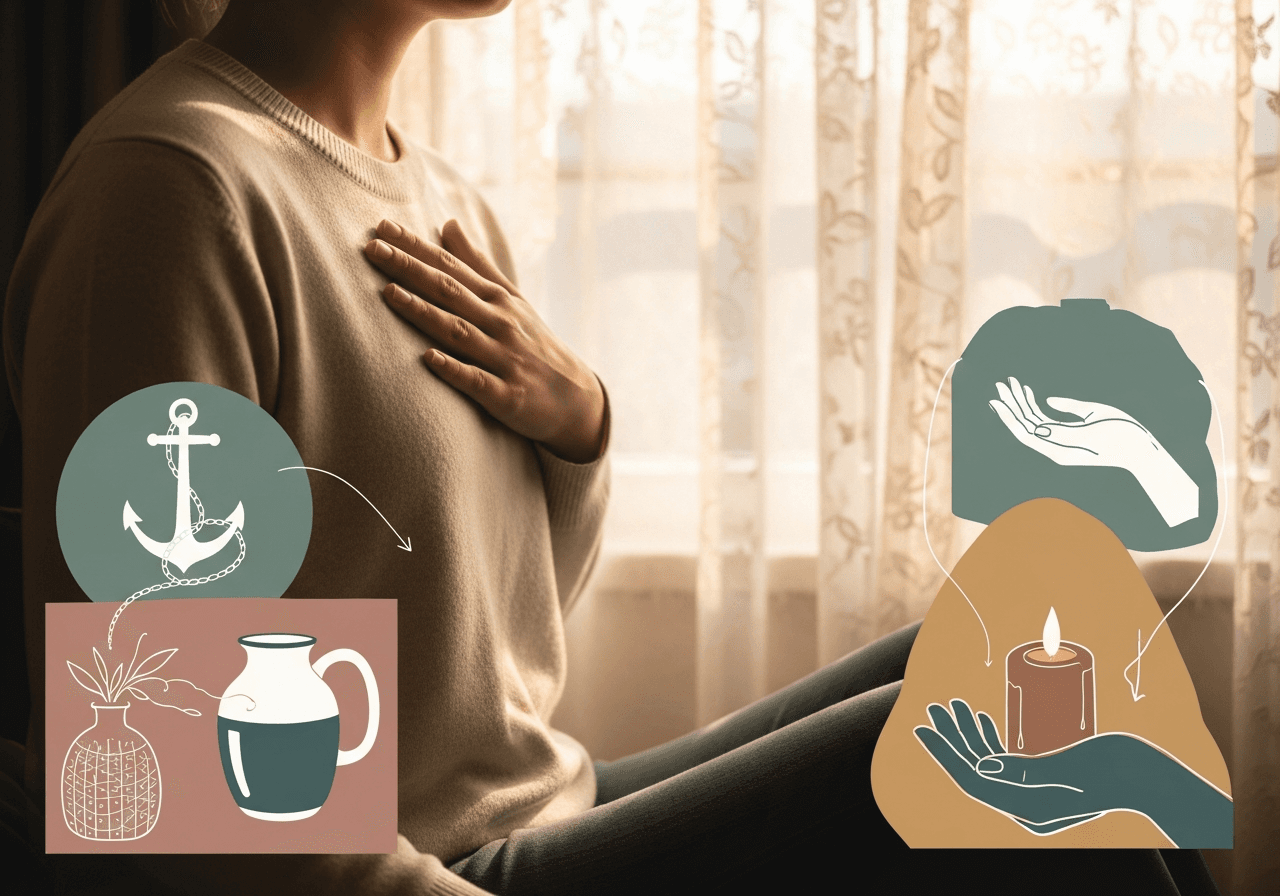
This is not toxic positivity. This is honest duality. And it is the shape of mature faith: holding suffering and hope in the same hand.
You Are Not Alone
If you are reading this and you struggle with anxiety — if Sunday mornings are sometimes harder than Mondays because the expectation to perform joy feels crushing — please know: you are not alone. You are not broken. You are not less faithful.
You are a whole person, body and soul, navigating a world that was not designed for the pace and pressure we've imposed on it. And the God who made you knows that. He is not surprised by your anxiety, and He is not disappointed. He is near.
"The Lord is nigh unto them that are of a broken heart; and saveth such as be of a contrite spirit." — Psalm 34:18
He is near. Right now. Even if you can't feel it.
If anxiety has been part of your story, consider sharing this with someone you trust. Breaking the silence is the first step toward healing.
Related reading
Anxiety wears many faces. These sit close to what you may be carrying:
- #anxiety
- #mental-health
- #faith
- #church
- #healing
I write about faith, motivation, and mental wellness because I believe one word from God can change everything. Mental Compass articles are researched against published studies and clinical sources. They are here to encourage and inform, not to replace care from a licensed professional.