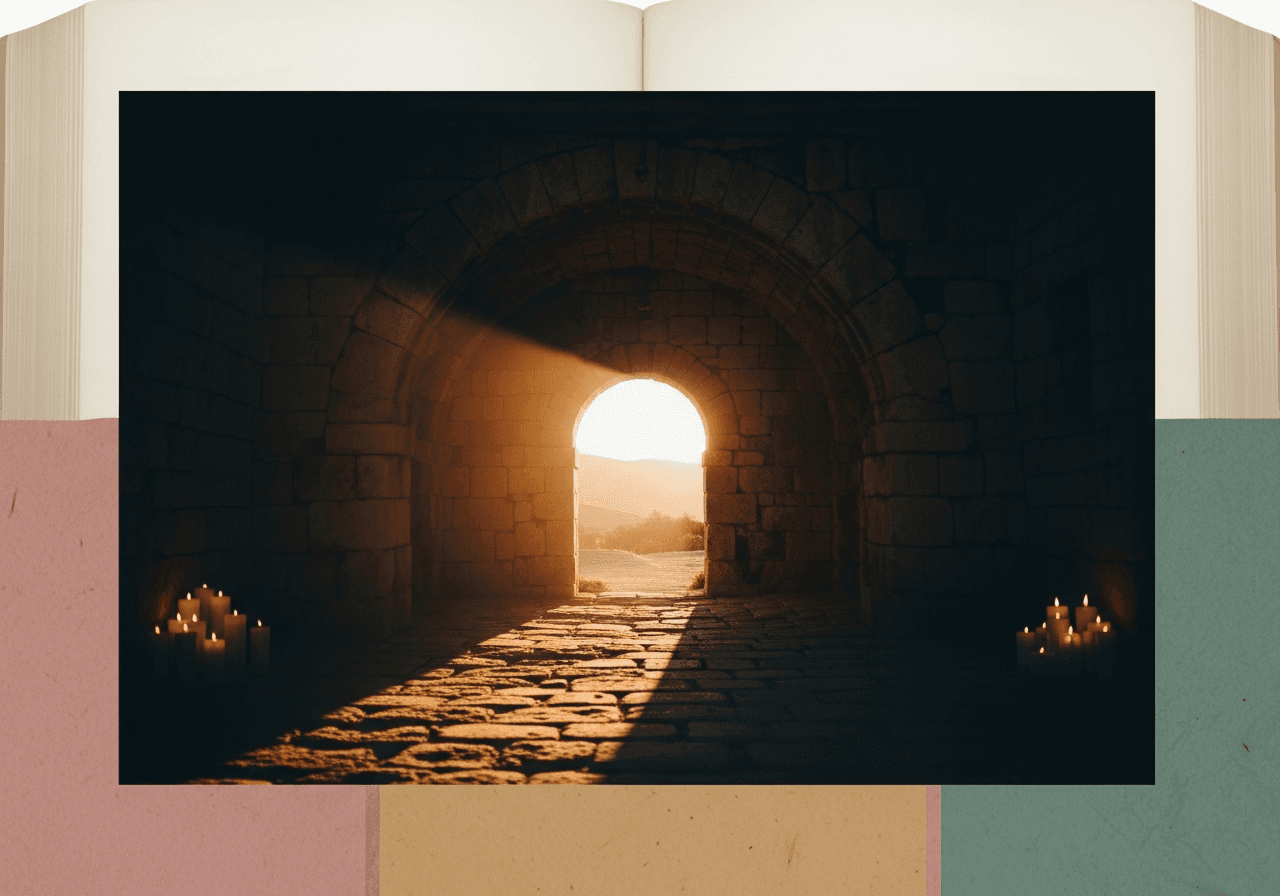
The Valley of the Shadow: What Psalm 23 Says When the Darkness Is Real
The most quoted verse for grief is also the most misread. The shepherd does not lead the sheep around the valley — He walks into it with them. The rod and staff are not soft comforts; they are working tools of rescue. Here is what Psalm 23:4 says when the darkness is real.
12 de mayo de 2026 · Actualizado 1 de septiembre de 2026 · 6 min de lectura
En este artículo· 4
"Yea, though I walk through the valley of the shadow of death, I will fear no evil: for thou art with me; thy rod and thy staff they comfort me." — Psalm 23:4, KJV
The shepherd does not lead the sheep around the valley; He walks into it with them, and the tools He carries are not soft comforts but the working instruments of rescue.
Where Does the Valley Sit in This Psalm, and Why Does That Matter?
Psalm 23 is six verses long. The valley is verse 4 — the middle. Most casual readers treat verse 4 as the climax or the conclusion, the dark patch the psalm finally arrives at. It is neither. Verses 1-3 set the scene of pasture, water, and restoration. Verse 4 enters the darkness. Verses 5-6 emerge to a prepared table, an anointed head, and the house of the LORD. The valley is a passage, not a destination. David is not writing from inside it; he is writing on the other side of it.
The verb is also worth noticing. "I walk through" — not stand, not stop, not live. The Hebrew construction implies passage. David has been through this valley already, more than once. The whole psalm is in the present tense of someone who has tested the geography and is reporting back. This is testimony, not theory.
Tradition attributes the psalm to David's later years, after he had been the shepherd boy, the fugitive hunted by Saul, the king mourning the son who tried to kill him. The voice in this psalm has buried friends, walked the wilderness of En Gedi, fled across the Jordan with a barefoot retinue (2 Samuel 15:30). When he writes about the valley, he is not speculating.
What Does "Valley of the Shadow of Death" Actually Mean in Hebrew?
The phrase translates the single Hebrew word tsalmaveth (Strong's H6757) — a compound of tsel (shadow) and maveth (death). Lexicons render it "deep darkness," "death-shadow," or "the shadow of death." It is used elsewhere in the Old Testament for places of overwhelming darkness — the grave (Job 10:21-22), the depths of the sea, the experience of being abandoned (Job 16:16, Psalm 44:19). It is not a metaphor for mild discomfort. It is the language of dying, of the pit, of the darkness in which orientation fails.
The KJV translators kept the full phrase "shadow of death" because the Hebrew has both elements. Modern translations that render it simply "darkest valley" lose the weight. Tsalmaveth is the darkness that has death's shape in it — bereavement, terminal diagnosis, the death of a marriage, the long night of depression that feels like a tomb. David names it with both words because both words are true.
Two grammatical details deserve attention. First, the preposition is through, not into. The valley is not the final dwelling. Second, the pronouns shift in this verse from third person to second: verses 1-3 say "He maketh me…He leadeth me." Verse 4 says "thou art with me." In the valley, the shepherd is no longer described from a distance. He is addressed directly. The darkness is what closes the gap.
What Are the Rod and the Staff, and Why Are They Comforting?
The rod (shevet, H7626) and the staff (mishenah, H4938) are two distinct tools of an ancient Near-Eastern shepherd, not decorative emblems. The rod is a short, heavy club, sometimes studded, used to defend the flock from predators — wolves, lions, bears — and to discipline straying sheep. The staff is longer, often with a crook, used to guide the sheep, to pull a fallen one out of a crevice, to count them at the fold. Matthew Henry's commentary on this verse notes that the shepherd's instruments are both defensive and corrective; they comfort precisely because they are working tools, not symbols.
This is what David finds comforting in the valley: not that the shepherd is soothing, but that the shepherd is armed and equipped. The wolves are real. The crevices are real. The rod will be swung. The staff will be hooked under his chest if he falls. Comfort, in the valley, is not the absence of threat. It is the presence of One whose tools were forged for exactly this terrain.
How Do You Walk This Verse When the Darkness Is Yours?
-
Stop expecting to be led around the valley. The shepherd's job, in this psalm, is not to spare the sheep the passage but to walk it with them. If you are in the valley, you are not off the path. The path goes through here.
-
Let the pronouns change in your prayers. When you can no longer say "the LORD is my shepherd" with confidence, say "thou art with me." The valley is the place where third-person theology becomes second-person address. Pray in the second person. He is in the room.
-
Name the tsalmaveth honestly. Do not soften the darkness to make it more spiritual. David did not. He used the heaviest Hebrew word available. Your grief, your diagnosis, your collapse — call it what it is, in prayer. The psalm gives you permission.
-
Trust the working tools more than the soft promises. The shepherd's rod is not a pleasant idea; it is a club He will swing at what is coming for you. The staff is not symbolic; it is the hook that will pull you back. Pray for the rod. Pray for the staff. Both are mercies.
-
Read to the end of the psalm. Verse 4 is not the last word. Verse 5: "Thou preparest a table before me in the presence of mine enemies." Verse 6: "Surely goodness and mercy shall follow me all the days of my life." If you stop in verse 4, you stop in the dark. David does not. Neither should you.
Reflection Prompts
- What valley are you currently walking through? Have you been asking the shepherd to lead you around it, when His promise is only to lead you through?
- Where in your prayers have you stayed in the third person — talking about God rather than to Him? What would it look like to address Him directly today?
- Which of the shepherd's tools do you need most right now — the rod that defends, or the staff that pulls you back? Ask for it by name.
May the Shepherd who has walked this valley before you, walk it with you now, swing His rod against what would devour you, hook His staff under you when you fall, and bring you out on the other side to the prepared table and the house of the LORD forever. Amen.
Cross-references
- John 10:11 (KJV) — "I am the good shepherd: the good shepherd giveth his life for the sheep." Jesus claims Psalm 23 in the first person. The shepherd of verse 4 has a face and a name.
- Job 10:21-22 — The other major Old Testament use of tsalmaveth. Job names the darkness from inside it; David names it on the way through. Both belong in scripture.
- Revelation 7:17 — The lamb who is also the shepherd, who leads them to "living fountains of waters." The end of every valley the psalm anticipates.
Related reading
When the darkness is not metaphorical, these walk the same road:
- #psalm 23
- #bible exegesis
- #kjv devotional
- #old testament
- #grief
- #hebrew word study
- #shepherd
Escribo sobre fe, motivación y bienestar mental porque creo que una palabra de Dios puede cambiarlo todo. Los artículos de Mental Compass se investigan con estudios publicados y fuentes clínicas. Están para animar e informar, no para reemplazar la atención de un profesional con licencia.