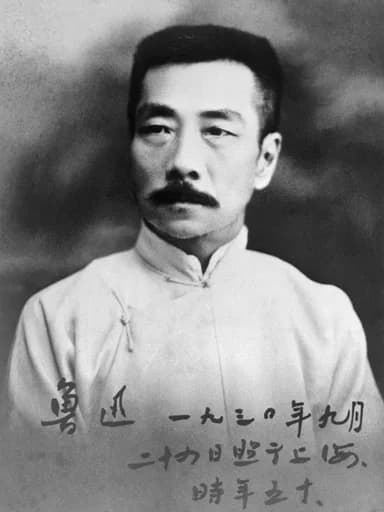
Despair can only be overcome by action.
Biography
About Lu Xun
Lu Xun (1881–1936), pen name of Zhou Shuren, is widely considered the founding father of modern Chinese literature. Born in Shaoxing, Zhejiang, he initially studied medicine in Japan before concluding that China's problems were spiritual and cultural rather than physical — and that literature, not medicine, was the cure. His "A Madman's Diary" (1918) is considered the first modern Chinese short story written in vernacular Chinese.
His major collections include Call to Arms (Nahan, 1923) and Wandering (Panghuang, 1926). His satirical essay "The True Story of Ah Q" is a devastating portrait of Chinese national psychology under imperialism. Mao Zedong praised him as "the saint of modern China," though Lu Xun died before the Communist victory and his actual political views were more complex.
Key Themes
Quick Facts
- Born
- 1881
- Died
- 1936
- Lifespan
- 55 yrs
- Quotes
- 5 collected
Wisdom
Lu Xun's Famous Quotes
“Despair can only be overcome by action.”
— Widely attributed to Lu Xun — consistent with themes across his essays and stories
Lu Xun wrote during a period of profound Chinese national crisis — the collapse of the Qing dynasty, warlordism, foreign occupation. His "Madman''s Diary" (1918) opens with a narrator paralyzed by a society that he perceives as cannibalistic. Action, in this context, is not merely a personal practice but a moral and political stance against the numbing despair that Lu Xun saw consuming Chinese intellectuals.
“Bravery is not the absence of fear but the action in spite of it.”
— Widely attributed — note: this exact wording is also associated with Nelson Mandela and Ambrose Redmoon; Lu Xun attribution uncertain
The idea that courage is action despite fear rather than absence of fear appears in many traditions and is associated with multiple figures. While this wording is sometimes attributed to Lu Xun, the exact phrasing is also traced to Ambrose Redmoon (James Neil Hollingworth) and circulates widely under Mandela''s name. The sentiment is consistent with Lu Xun''s documented philosophy, but the exact authorship is uncertain.
“Hope is like a path in the countryside. Originally, there is nothing—but as people walk this way again and again, a path appears.”
— "My Old Home" (故乡, 1921) — closing lines
Lu Xun''s short story "My Old Home" ends with the narrator leaving his village and reflecting on hope versus despair. This closing image — that hope, like a path, is created by people walking it together — is one of the most famous sentences in modern Chinese literature. It rejects both naive optimism (hope as something that exists waiting to be found) and nihilism (nothing can be done) in favor of collective action as the only reliable source of possibility.
“To be truly modern, one must first be Chinese.”
— Widely attributed to Lu Xun — consistent with his documented philosophy of cultural modernization
Lu Xun argued throughout his career that China''s modernization required deep engagement with its own cultural foundations rather than wholesale importation of Western models. He criticized both reactionaries (who rejected modernity entirely) and wholesale Westernizers (who rejected Chinese culture entirely). True modernity, in his view, required knowing what you are transforming — which demands first being fully grounded in it.
“Lies written in ink cannot disguise facts written in blood.”
— "Written After a Silent China" (无声的中国, essay, 1927)
Lu Xun wrote this during the period of White Terror following Chiang Kai-shek''s purge of Communist Party members in 1927, when censorship was brutal and political violence against writers was common. The contrast between ink (government propaganda, official lies) and blood (the reality of what was being done to people) is not metaphorical — it describes a specific political moment where state power was deploying language to disguise atrocities.
From the Blog
Related Reading
Discover
More Thought Leaders
Need to Know
Frequently Asked Questions
Lu Xun (1881–1936), pen name of Zhou Shuren, is widely considered the founding father of modern Chinese literature. Born in Shaoxing, Zhejiang, he initially studied medicine in Japan before concluding that China's problems were spiritual and cultural rather than physical — and that literature, not medicine, was the cure. His "A Madman's Diary" (1918) is considered the first modern Chinese short story written in vernacular Chinese. His major collections include Call to Arms (Nahan, 1923) and Wandering (Panghuang, 1926). His satirical essay "The True Story of Ah Q" is a devastating portrait of Chinese national psychology under imperialism. Mao Zedong praised him as "the saint of modern China," though Lu Xun died before the Communist victory and his actual political views were more complex. Lu Xun lived 1881 – 1936.
Morning Practice
Continue Your Daily Reflection
Daily faith-based affirmations and quotes from inspiring thinkers like Lu Xun.
Free access. New quotes & reflections every day.