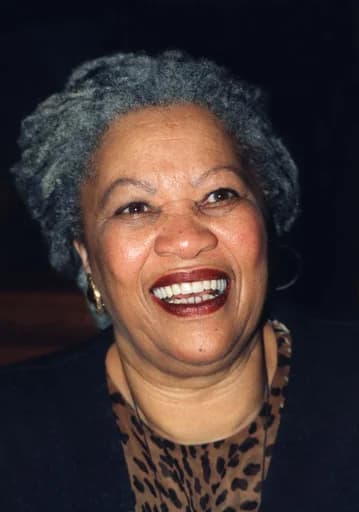
Toni Morrison
Make a difference about something other than yourselves.
Biography
About Toni Morrison
Toni Morrison (1931–2019) was an American novelist, editor, and professor, and the first Black woman to receive the Nobel Prize in Literature (1993). Born Chloe Ardelia Wofford in Lorain, Ohio, she graduated from Howard University and Cornell and spent 18 years as an editor at Random House, where she championed Black American literature while writing her own novels at night. Her major works — The Bluest Eye (1970), Sula (1973), Song of Solomon (1977), Tar Baby (1981), Beloved (1987), Jazz (1992), and Paradise (1997) — form one of American literature's most coherent and devastating bodies of work on the experience of Black life, memory, and freedom.
Beloved won the Pulitzer Prize in 1988. She taught at Princeton for 17 years.
Key Themes
Quick Facts
- Born
- 1931
- Died
- 2019
- Lifespan
- 88 yrs
- Quotes
- 4 collected
Photo: John Mathew Smith (celebrity-photos.com) / CC BY-SA 2.0 / Source Resized and converted to WebP from the original.
Wisdom
Toni Morrison's Famous Quotes
“Make a difference about something other than yourselves.”
Morrison delivered this challenge in various commencement speeches as a corrective to the self-focused achievement culture of American higher education. Her argument was that genuine purpose requires orienting outward — beyond personal success, beyond representation, beyond "making it" — toward the actual conditions of the world. As the first Black woman to win the Nobel Prize in Literature (1993), she was positioned to say this with authority: the point of achievement is what you do with it.
“If there's a book that you want to read, but it hasn't been written yet, then you must write it.”
— Speech, Ohio Arts Council (1981), 1981
Morrison gave this instruction in multiple interviews when asked about her path to becoming a novelist. Her first novel, The Bluest Eye (1970), was the book she needed to read and found didn''t exist — a story about a Black girl''s experience of self-hatred and desire for whiteness. She wrote it for herself at 36, while raising two sons and working as an editor at Random House. The instruction is both personal and universal: unmet need is the most direct path to original work.
“Freeing yourself was one thing, claiming ownership of that freed self was another.”
This distinction — between liberation and ownership of a liberated self — is one of the central tensions in Beloved, Morrison''s novel about Sethe, an escaped enslaved woman haunted by what she did to protect her daughter from returning to slavery. Freedom, Morrison argues, is not a single act of escape but an ongoing work of psychological reclamation: claiming the full humanity that the system of slavery had systematically denied.
“Definitions belong to the definers, not the defined.”
This appears in Tar Baby as an observation about power: those with the authority to name — to categorize and label — exercise a form of control that the named do not consent to. Morrison applied this throughout her career to the American racial taxonomy: the categories "Black" and "white" were definitions created by those who benefited from the hierarchy, not neutral descriptions. Language, she insisted, is always political.
From the Blog
Related Reading
Discover
More Thought Leaders
Need to Know
Frequently Asked Questions
Toni Morrison (1931–2019) was an American novelist, editor, and professor, and the first Black woman to receive the Nobel Prize in Literature (1993). Born Chloe Ardelia Wofford in Lorain, Ohio, she graduated from Howard University and Cornell and spent 18 years as an editor at Random House, where she championed Black American literature while writing her own novels at night. Her major works — The Bluest Eye (1970), Sula (1973), Song of Solomon (1977), Tar Baby (1981), Beloved (1987), Jazz (1992), and Paradise (1997) — form one of American literature's most coherent and devastating bodies of work on the experience of Black life, memory, and freedom. Beloved won the Pulitzer Prize in 1988. She taught at Princeton for 17 years. Toni Morrison lived 1931 – 2019.
Morning Practice
Continue Your Daily Reflection
Daily faith-based affirmations and quotes from inspiring thinkers like Toni Morrison.
Free access. New quotes & reflections every day.