It is not true that people stop pursuing dreams because they grow old, they grow old because they stop pursuing dreams.
Biography
About Gabriel García Márquez
Gabriel García Márquez (1927–2014), known affectionately as "Gabo," was a Colombian novelist, journalist, and screenwriter, and one of the most significant writers of the 20th century. Born in Aracataca, Colombia, he was raised largely by his grandparents — his grandmother's matter-of-fact storytelling style became the template for magical realism. One Hundred Years of Solitude (1967) took the world by storm, establishing him as a global literary figure.
He received the Nobel Prize in Literature in 1982. His other major works include Love in the Time of Cholera (1985) and his autobiography Living to Tell the Tale (2002). He spent decades as a journalist, convinced that journalism and fiction were different expressions of the same truth-telling impulse.
Key Themes
Quick Facts
- Born
- 1927
- Died
- 2014
- Lifespan
- 87 yrs
- Quotes
- 4 collected
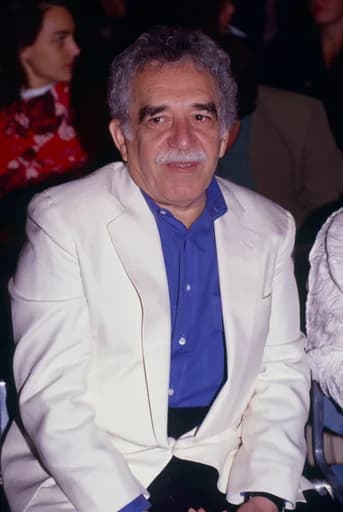
Photo: Gorup de Besanez / CC BY-SA 4.0 / Source Resized and converted to WebP from the original.
Wisdom
Gabriel García Márquez's Famous Quotes
“It is not true that people stop pursuing dreams because they grow old, they grow old because they stop pursuing dreams.”
— Widely attributed to García Márquez — exact source uncertain; consistent with his public statements
García Márquez used this idea in various interviews as a reflection on the aging he observed around him — not physical decline but the gradual retreat from imagination and ambition. His own life refuted it: he was over 40 when One Hundred Years of Solitude was published (1967), having spent years in financial difficulty. The novel''s success came not from youth but from accumulated life — and the refusal to stop dreaming through it.
“What matters in life is not what happens to you but what you remember and how you remember it.”
— Living to Tell the Tale (Vivir para contarla, 2002) — autobiography
These are the opening words of García Márquez''s autobiography — specifically his claim about how memory works. He is not saying that only pleasant memories matter, but that memory is always an act of construction: you don''t replay events, you reconstruct them, selecting and shaping them into a narrative. His fiction is built on this principle. Magical realism is not a departure from reality but a more honest account of how memory and experience actually feel from the inside.
“No medicine cures what happiness cannot.”
— Widely attributed to García Márquez — consistent with his documented statements and themes
This line distills García Márquez''s consistent view that joy is not a luxury but a form of medicine — and that medicine is not the highest form of healing. He grew up in Aracataca, Colombia, in a household full of stories, myths, and a grandmother who spoke of the fantastical as ordinary fact. His magical realism was built on the conviction that emotional and spiritual realities are more powerful than pharmaceutical ones.
“There is always something left to love.”
— One Hundred Years of Solitude (1967), trans. Gregory Rabassa
This line appears in the later sections of his masterwork as a consolation offered to Amaranta Úrsula. García Márquez''s novel is saturated with losses — of memory, of people, of the Buendía family itself — and this phrase offers not optimism but a precise observation: love is not finite. The claim is not that grief ends but that the capacity to love persists through it. It remains one of the most widely quoted lines from the novel.
From the Blog
Related Reading
Discover
More Thought Leaders

Need to Know
Frequently Asked Questions
Gabriel García Márquez (1927–2014), known affectionately as "Gabo," was a Colombian novelist, journalist, and screenwriter, and one of the most significant writers of the 20th century. Born in Aracataca, Colombia, he was raised largely by his grandparents — his grandmother's matter-of-fact storytelling style became the template for magical realism. One Hundred Years of Solitude (1967) took the world by storm, establishing him as a global literary figure. He received the Nobel Prize in Literature in 1982. His other major works include Love in the Time of Cholera (1985) and his autobiography Living to Tell the Tale (2002). He spent decades as a journalist, convinced that journalism and fiction were different expressions of the same truth-telling impulse. Gabriel García Márquez lived 1927 – 2014.
Morning Practice
Continue Your Daily Reflection
Daily faith-based affirmations and quotes from inspiring thinkers like Gabriel García Márquez.
Free access. New quotes & reflections every day.