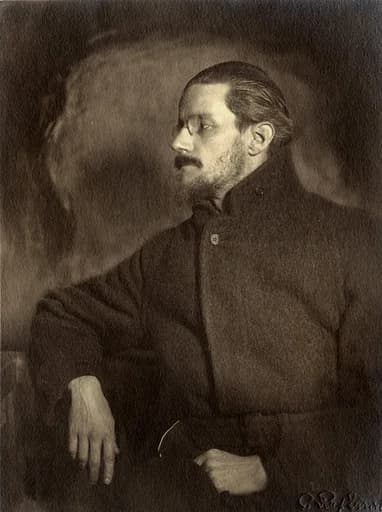
History is a nightmare from which I am trying to awake.
Biography
About James Joyce
James Joyce (1882–1941) was an Irish novelist, poet, and short story writer, widely considered the most influential prose innovator of the 20th century. Born in Dublin, he spent most of his adult life in self-imposed exile in Trieste, Zurich, and Paris, writing obsessively about the city he had left. His major works — Dubliners (1914), A Portrait of the Artist as a Young Man (1916), Ulysses (1922), and Finnegans Wake (1939) — progressively dismantled conventional narrative, syntax, and representation.
Ulysses, which charts a single day in Dublin on 16 June 1904, is routinely named the greatest novel in the English language. His technique of stream-of-consciousness transformed fiction permanently.
Key Themes
Quick Facts
- Born
- 1882
- Died
- 1941
- Lifespan
- 59 yrs
- Quotes
- 5 collected
Wisdom
James Joyce's Famous Quotes
“History is a nightmare from which I am trying to awake.”
Stephen Dedalus says this to his employer Mr. Deasy, who has been lecturing him on history and English superiority. For Stephen — and for Joyce, who spent most of his life in voluntary exile from Ireland — history was not the triumphant narrative of the powerful but a weight pressing on individual consciousness. The desire to "awake" from it is not escapism but the desire for a present that is not determined by inherited violence and grievance.
“A man of genius makes no mistakes. His errors are volitional and are the portals of discovery.”
Stephen makes this point during a debate in the National Library about Shakespeare''s identity and the relationship between biography and art. The philosophical claim is important: genius is not defined by infallibility but by the purposefulness of its departures from convention. An error made unconsciously is a failure; an error made with full awareness of the rule being broken is an act of discovery. Joyce himself famously violated virtually every convention of the novel — deliberately.
“I am, a stride at a time. A very short space of time through very short times of space.”
This passage is from Stephen Dedalus''s stream-of-consciousness as he walks on Sandymount Strand, constructing a philosophical meditation on space, time, and existence from the rhythm of his own footsteps. Joyce is exploring what he called "ineluctable modality" — the way consciousness converts the world into mental constructs. The spare rhythm of the sentence ("a stride at a time") mimics walking itself, making form and content identical.
“Think you're escaping and run into yourself. Longest way round is the shortest way home.”
This is Joyce''s typically ironic version of a spiritual insight: the attempt to escape yourself — through travel, through masks, through reinvention — ultimately leads you back to yourself. The "longest way round" in Ulysses is Leopold Bloom''s 18-hour journey through Dublin, which ends at his own front door. The epic wandering is also a homecoming. Joyce spent most of his adult life in Paris, Trieste, and Zurich — and spent it writing about Dublin.
“Love loves to love love.”
Joyce is having fun with language here — the circular repetition of "love" is both a stylistic joke and a statement: love is self-referential, self-generating, indefinitely recursive. He uses this in the "Cyclops" chapter partly to contrast with the Citizen''s aggressive nationalism. The sentence is structurally playful but philosophically serious: it argues that love doesn''t need external justification. It is simply what love does.
From the Blog
Related Reading
Discover
More Thought Leaders
Need to Know
Frequently Asked Questions
James Joyce (1882–1941) was an Irish novelist, poet, and short story writer, widely considered the most influential prose innovator of the 20th century. Born in Dublin, he spent most of his adult life in self-imposed exile in Trieste, Zurich, and Paris, writing obsessively about the city he had left. His major works — Dubliners (1914), A Portrait of the Artist as a Young Man (1916), Ulysses (1922), and Finnegans Wake (1939) — progressively dismantled conventional narrative, syntax, and representation. Ulysses, which charts a single day in Dublin on 16 June 1904, is routinely named the greatest novel in the English language. His technique of stream-of-consciousness transformed fiction permanently. James Joyce lived 1882 – 1941.
Morning Practice
Continue Your Daily Reflection
Daily faith-based affirmations and quotes from inspiring thinkers like James Joyce.
Free access. New quotes & reflections every day.