Malala Yousafzai
b. 1997
About Malala Yousafzai
Malala Yousafzai (born 1997 in Mingora, Pakistan) is a Pakistani education activist and the youngest Nobel Peace Prize laureate in history (2014, age 17). Growing up in the Swat Valley under Taliban occupation, she began blogging anonymously for BBC Urdu at age 11, documenting the destruction of girls' schools and daily life under extremist rule. She was shot in the head on her school bus at 15 and survived after treatment in Pakistan and the UK.
Rather than retreating, she intensified her advocacy. She co-founded the Malala Fund in 2013, which works toward 12 years of free, quality education for every girl. Her autobiography I Am Malala (2013) became an international bestseller.
“When the whole world is silent, even one voice becomes powerful.”
Quick Facts
- Born
- 1997
- Age
- 29 years
- Domain
- leadership
- Quotes
- 4 collected
- Key Themes
- VoiceLegacyAdvocacyEducation
Learn More
Wikipedia — Malala YousafzaiMalala Yousafzai's Famous Quotes
4 quotes
“When the whole world is silent, even one voice becomes powerful.”
— I Am Malala: The Story of the Girl Who Stood Up for Education (2013)
“I don't want to be remembered as the girl who was shot. I want to be remembered as the girl who stood up.”
— I Am Malala (2013) and Nobel Peace Prize Lecture, 10 December 2014
“We realize the importance of our voices only when we are silenced.”
— I Am Malala: The Girl Who Stood Up for Education and Was Shot by the Taliban (2013)
“One child, one teacher, one book, one pen can change the world.”
— Nobel Peace Prize Lecture, Oslo, 10 December 2014
Explore Related Content
Articles and guides inspired by leadership thinkers like Malala Yousafzai
Failure Is Not the Opposite of Success — It Is Information
Treating failure as a verdict rather than a data point is the single most common reason intelligent people stop short of becoming good at the things they care about most. The opposite of success is not failure. It is ignorance.
Read article →
Work-Life Balance Is a Myth. Here's What Actually Works.
Balance implies two equal sides held in static equilibrium. Most adult lives are not built this way. The actual problem is not imbalance — it is treating recovery as optional and integration as impossible.
Read article →
Marcus Aurelius Never Planned to Be Emperor — and That Made Him Great
Marcus Aurelius did not want to be emperor. He wrote Meditations as private notes to himself, never intending publication. The most-quoted Stoic text in history is a man arguing with his own weakness in the dark — and that is why it still works.
Read article →
More leadership
Browse all authors →
Winston Churchill
Sir Winston Churchill (1874–1965) was a British statesman, soldier, and writer who served as Prime Minister of the United Kingdom during the Second World War (1940–1945) and again from 1951–1955. Widely regarded as one of the greatest wartime leaders in history, he rallied Britain against Nazi Germany at its most isolated moment with speeches that defined the era. He was also a prolific author, winning the Nobel Prize in Literature in 1953 for his historical writings, including the six-volume The Second World War. Churchill's career was marked by spectacular failures — including the Gallipoli disaster in WWI — and remarkable recoveries, making his life one of the 20th century's most compelling examples of persistence. Note: Churchill is among the most misquoted figures in history; many popular quotes attributed to him cannot be verified in his documented writings.

Donald Trump
Donald Trump (born 1946) is an American businessman, television personality, and politician who served as the 45th President of the United States from 2017 to 2021 and was elected as the 47th President in 2024. Born in Queens, New York, Trump built a real estate empire under the Trump Organization before becoming a household name through his reality television series "The Apprentice." Known for his brash, outspoken style, Trump leveraged his celebrity brand into a successful 2016 presidential campaign on themes of economic nationalism and anti-establishment politics. His presidency was marked by sweeping tax cuts, deregulation, and a confrontational trade policy with China, as well as a deeply polarized political climate. After the January 6, 2021 Capitol breach and his subsequent second impeachment (acquitted by the Senate), he remained the dominant figure in the Republican Party, running again in 2024 and securing a second term. He is one of the most consequential and controversial figures in modern American political history.

Nelson Mandela
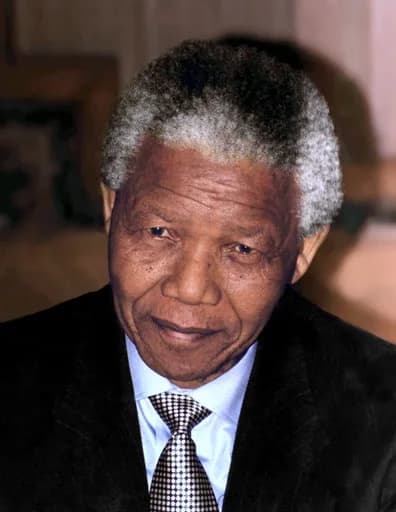
Nelson Mandela (1918–2013) was a South African anti-apartheid revolutionary, lawyer, and statesman who served as the first Black President of South Africa (1994–1999) following 27 years of imprisonment. He co-founded the ANC Youth League and later led the ANC's armed resistance wing before his arrest in 1964. Imprisoned on Robben Island until 1990, he emerged to negotiate a peaceful transition from apartheid to democracy — widely considered one of the most remarkable political achievements of the 20th century. He received the Nobel Peace Prize in 1993, shared with F.W. de Klerk. His autobiography, Long Walk to Freedom (1994), remains one of the most important memoirs of the modern era.

Frida Kahlo
Frida Kahlo (1907–1954) was a Mexican painter whose vivid self-portraits and intensely personal imagery made her one of the most recognizable and studied artists of the 20th century. At 6 she contracted polio; at 18 she survived a bus accident that fractured her spine, pelvis, collarbone, and crushed her right leg — initiating a lifetime of medical procedures (35+ surgeries) and chronic pain. Confined to recovery, she began painting. Her work, often dismissed by the Surrealists as autobiography, is now understood as a precise phenomenological record of her physical and emotional experience. She was deeply involved in Mexican politics and culture, and her turbulent relationship with muralist Diego Rivera defined much of her adult life. Her diary, published posthumously, reveals the full scope of her literary imagination.
Frequently Asked Questions
Malala Yousafzai (born 1997 in Mingora, Pakistan) is a Pakistani education activist and the youngest Nobel Peace Prize laureate in history (2014, age 17). Growing up in the Swat Valley under Taliban occupation, she began blogging anonymously for BBC Urdu at age 11, documenting the destruction of girls' schools and daily life under extremist rule. She was shot in the head on her school bus at 15 and survived after treatment in Pakistan and the UK. Rather than retreating, she intensified her advocacy. She co-founded the Malala Fund in 2013, which works toward 12 years of free, quality education for every girl. Her autobiography I Am Malala (2013) became an international bestseller. Malala Yousafzai lived b. 1997.