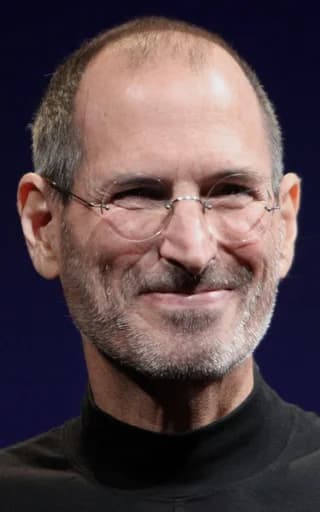
Steve Jobs
Have the courage to follow your heart and intuition.
Biography
About Steve Jobs
, and one of the most consequential figures in the history of technology and design. Adopted at birth and raised in Silicon Valley, he co-founded Apple in a garage with Steve Wozniak and Ronald Wayne in 1976. After being ousted from Apple in 1985, he founded NeXT and acquired Pixar Animation Studios, which produced Toy Story (1995).
He returned to Apple in 1997 and led the development of the iMac, iPod (2001), iTunes, iPhone (2007), and iPad (2010) — products that redefined the personal computer, music, communication, and tablet industries. He died of pancreatic neuroendocrine tumor at 56. His Stanford commencement address (2005) is one of the most-watched speeches in history.
Key Themes
Quick Facts
- Born
- 1955
- Died
- 2011
- Lifespan
- 56 yrs
- Quotes
- 6 collected
Photo: MetalGearLiquid, based on File:Steve_Jobs_Headshot_2010-CROP.jpg made by Matt Yohe / CC BY-SA 3.0 / Source Resized and converted to WebP from the original.
Wisdom
Steve Jobs's Famous Quotes
“Have the courage to follow your heart and intuition.”
— Stanford University Commencement Address, 2005
Jobs delivered his three-story commencement address at Stanford months after being diagnosed with pancreatic cancer. This line closes his advice on death: the knowledge of mortality clarifies what actually matters and silences the fear of embarrassment, failure, or judgment that keeps people from following their genuine convictions. He was drawing directly from his own experience of facing death at 49.
“Your time is limited, so don't waste it living someone else's life.”
— Stanford University Commencement Address, 2005
Jobs said this at Stanford in the context of facing death: knowing his time was limited made the question of how to use it urgent rather than abstract. He was specifically speaking against the social pressure to pursue others'' definitions of success — the family''s expectations, the market''s demands, the company''s trajectory. He had experienced this pressure himself, having been pushed out of his own company.
“The only way to do great work is to love what you do.”
— Stanford University Commencement Address, 2005
This was the central message of his second Stanford story — about being fired from Apple at 30. Jobs described being fired as the best thing that ever happened to him: freed from the weight of success, he started NeXT and Pixar. When he returned to Apple in 1997, it was with a clarity of purpose he could not have had without the intervening failure. The claim — that great work requires love of the work — was not platitude but autobiography.
“Design is not just what it looks like and feels like. Design is how it works.”
— The Guts of a New Machine (New York Times Magazine), 2003
Jobs said this in multiple interviews as a rebuttal to the market research approach to product design. He was specifically critiquing the idea that consumers could tell you what they wanted before they had seen it. Apple products — the Mac, iPod, iPhone — were designed around this conviction: function and form are inseparable, and a product''s experience of use is identical with its design.
“I'm convinced that about half of what separates the successful entrepreneurs from the non-successful ones is pure perseverance.”
— Computerworld Smithsonian Awards Oral History Interview, 1995
Jobs said this in a 1995 interview when discussing why so many technically superior companies had failed to build lasting products. His own career demonstrated it: Apple was near bankruptcy when he returned in 1997, and his turnaround required not just vision but sustained, daily effort through years of difficult execution. Perseverance was, he argued, the unsexy differentiator that separated good ideas from actual companies.
“Sometimes life hits you in the head with a brick. Don't lose faith.”
— Stanford University Commencement Address, 2005
Jobs said this in his Stanford speech''s first story — about dropping out of Reed College — where he framed his own experience of cancer as a clarifying force. The "brick" is mortality, crisis, or failure that demolishes the scaffolding of ordinary life and forces re-evaluation. His instruction "don''t lose faith" is not about religion but about the conviction that your own path — however disrupted — is still navigable.
From the Blog
Related Reading
Discover
More Thought Leaders

Need to Know
Frequently Asked Questions
Steve Jobs (1955–2011) was the co-founder, chairman, and chief executive of Apple Inc., and one of the most consequential figures in the history of technology and design. Adopted at birth and raised in Silicon Valley, he co-founded Apple in a garage with Steve Wozniak and Ronald Wayne in 1976. After being ousted from Apple in 1985, he founded NeXT and acquired Pixar Animation Studios, which produced Toy Story (1995). He returned to Apple in 1997 and led the development of the iMac, iPod (2001), iTunes, iPhone (2007), and iPad (2010) — products that redefined the personal computer, music, communication, and tablet industries. He died of pancreatic neuroendocrine tumor at 56. His Stanford commencement address (2005) is one of the most-watched speeches in history. Steve Jobs lived 1955 – 2011.
Morning Practice
Continue Your Daily Reflection
Daily faith-based affirmations and quotes from inspiring thinkers like Steve Jobs.
Free access. New quotes & reflections every day.