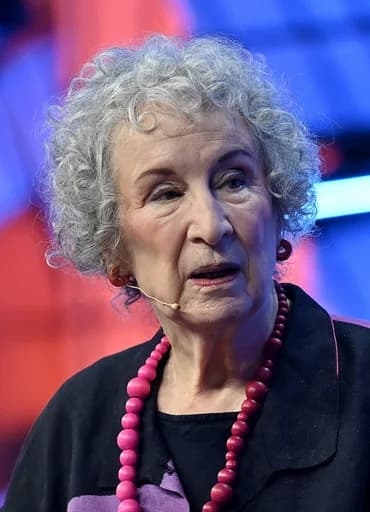
War is what happens when language fails.
Biography
About Margaret Atwood
Margaret Atwood (born 1939) is a Canadian novelist, poet, and critic widely regarded as one of the most important living authors in the English language. Born in Ottawa and raised partly in the northern Ontario wilderness, she studied at Victoria University and Radcliffe College. Her breakthrough novel *The Edible Woman* (1969) announced her feminist preoccupations; *The Handmaid's Tale* (1985) — a dystopian novel about a theocratic patriarchy — became her most internationally known work, reinvigorated by the 2017 Hulu adaptation during the Trump era.
She has won the Booker Prize twice — for *The Blind Assassin* (2000) and *The Testaments* (2019). She has published more than 50 works of fiction, poetry, and criticism, and remains an outspoken public voice on environmental collapse, authoritarianism, and gender politics.
Key Themes
Wisdom
Margaret Atwood's Famous Quotes
“War is what happens when language fails.”
From her Cambridge lectures on the nature of the writing life, Atwood here diagnoses communication breakdown as the root of armed conflict. When shared language — metaphor, argument, narrative — collapses, violence fills the vacuum. The line is characteristically compact: it says everything without editorializing. Atwood has been a consistent voice on nuclear disarmament and environmental collapse as failures of collective language.
“A word after a word after a word is power.”
— Spelling (in True Stories), 1981
The poem "Spelling" moves from a child learning the alphabet to the idea that language — accumulated word by word — is the fundamental act of human agency. Atwood refuses to romanticize writing; power accrues through patient accumulation, not inspiration. The poem also carries feminist weight: it is written in the context of women's long exclusion from literacy and public speech, recasting each written word as a recovered right.
“Don't let the bastards grind you down.”
Atwood invented this as deliberately bad mock-Latin — it means nothing in real Latin — but Offred finds it scratched into the floor of her room by a previous Handmaid and treats it as a sacred inheritance. It became one of the most iconic lines in the novel, worn on protest signs globally after the 2017 TV adaptation's release. The imperfect Latin is part of the point: resistance can be imprecise and still sustain life.
“In the end, we'll all become stories.”
— Moral Disorder ("The Entities"), 2006
Atwood has expressed this idea in many interviews — that once we die, we exist only in the memories and stories others carry. It reframes mortality: you do not cease to be, you become narrative. This connects to her recurring fictional interest in archives, testimony, and whose version of events survives. It is also a statement about the purpose of literature: to make the dead speak.
From the Blog
Related Reading
Discover
More Thought Leaders
Need to Know
Frequently Asked Questions
Margaret Atwood (born 1939) is a Canadian novelist, poet, and critic widely regarded as one of the most important living authors in the English language. Born in Ottawa and raised partly in the northern Ontario wilderness, she studied at Victoria University and Radcliffe College. Her breakthrough novel *The Edible Woman* (1969) announced her feminist preoccupations; *The Handmaid's Tale* (1985) — a dystopian novel about a theocratic patriarchy — became her most internationally known work, reinvigorated by the 2017 Hulu adaptation during the Trump era. She has won the Booker Prize twice — for *The Blind Assassin* (2000) and *The Testaments* (2019). She has published more than 50 works of fiction, poetry, and criticism, and remains an outspoken public voice on environmental collapse, authoritarianism, and gender politics. Margaret Atwood lived b. 1939.
Morning Practice
Continue Your Daily Reflection
Daily faith-based affirmations and quotes from inspiring thinkers like Margaret Atwood.
Free access. New quotes & reflections every day.