The highest point at which human life and art meet is death.
Biography
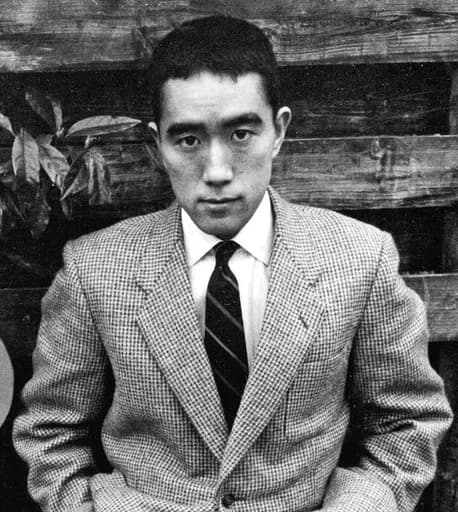
About Yukio Mishima
Yukio Mishima (1925–1970) was a Japanese author whose prolific and intensely aesthetic body of work established him as one of the most celebrated — and controversial — writers of 20th-century Japan. Born Kimitake Hiraoka in Tokyo, he published his debut novel at 14 under his pen name. His major works — including *Confessions of a Mask* (1949), *The Temple of the Golden Pavilion* (1956), and *The Sea of Fertility* tetralogy (1969–70) — explored beauty, death, masculinity, and Japanese identity with obsessive intensity.
He was nominated for the Nobel Prize three times. In 1970 he led a paramilitary group in a failed coup attempt at a Tokyo military headquarters and then performed ritual suicide (seppuku) before an assembled crowd. He completed his final novel the day before his death.
His life and work remain inseparably entangled in Japanese cultural memory.
Key Themes
Quick Facts
- Born
- 1925
- Died
- 1970
- Lifespan
- 45 yrs
- Quotes
- 5 collected
Wisdom
Yukio Mishima's Famous Quotes
“The highest point at which human life and art meet is death.”
— Sun and Steel (1968)
In this autobiographical essay on body, art, and the will, Mishima argued that literature and flesh must converge at the moment of maximum intensity — which for him was death. He saw the meeting point of life and art as necessarily destructive, because pure form requires the dissolution of the formless living body. Two years after writing this, he performed ritual suicide (seppuku) following a failed coup attempt, making the statement disturbingly prophetic.
“True beauty is something that attacks, overpowers, robs, and finally destroys.”
— The Temple of the Golden Pavilion (1956)
Mishima's novel, based on the 1950 arson of Kinkaku-ji temple by a monk, builds to the conclusion that beauty which cannot be possessed must be destroyed. The novice narrator becomes so tormented by the temple's perfection that he burns it down to end its power over him. Mishima here exposes the violence latent in aesthetic obsession — the desire to end beauty rather than endure its indifference.
“Perfect purity is possible if you turn your life into a line of poetry written with a splash of blood.”
— Sun and Steel (1968)
Mishima's ideal of purity was inseparable from his aesthetics of death — a life lived as a complete work of art, stained with nothing accidental or compromised. He was obsessed with the samurai concept of *mono no aware* (the pathos of impermanence) and the Bushido ideal of dying at the height of one's powers rather than in decline. He realized this ideal literally on November 25, 1970, dying at 45 in an act he had been planning for years.
“If we value so highly the dignity of life, how can we not also value the dignity of death?”
— The Sailor Who Fell from Grace with the Sea (1963)
Mishima's novel explores the tension between the pure death-drive of youth and the compromised living of adults. The novel's young protagonist becomes disillusioned when a heroic sailor chooses domestic life over his mythic identity. Mishima poses dignity as inseparable from the awareness of death — a Nietzschean position that defines his entire body of work and ultimately his self-staged death.
“What transforms this world is—knowledge. Do you see what I mean? Nothing else can change anything in this world.”
— The Temple of the Golden Pavilion (1956)
Mishima places this through his narrator — a man who has burned down Japan's most revered temple — as a statement about the transformative power of understanding over all other forces. The line has been read as a defense of art, of religion, and of revolutionary politics, depending on context. Mishima himself used it to justify his rightist nationalism: that ideological knowledge, not military strength, changes civilization.
From the Blog
Related Reading
Discover
More Thought Leaders
Need to Know
Frequently Asked Questions
Yukio Mishima (1925–1970) was a Japanese author whose prolific and intensely aesthetic body of work established him as one of the most celebrated — and controversial — writers of 20th-century Japan. Born Kimitake Hiraoka in Tokyo, he published his debut novel at 14 under his pen name. His major works — including *Confessions of a Mask* (1949), *The Temple of the Golden Pavilion* (1956), and *The Sea of Fertility* tetralogy (1969–70) — explored beauty, death, masculinity, and Japanese identity with obsessive intensity. He was nominated for the Nobel Prize three times. In 1970 he led a paramilitary group in a failed coup attempt at a Tokyo military headquarters and then performed ritual suicide (seppuku) before an assembled crowd. He completed his final novel the day before his death. His life and work remain inseparably entangled in Japanese cultural memory. Yukio Mishima lived 1925 – 1970.
Morning Practice
Continue Your Daily Reflection
Daily faith-based affirmations and quotes from inspiring thinkers like Yukio Mishima.
Free access. New quotes & reflections every day.