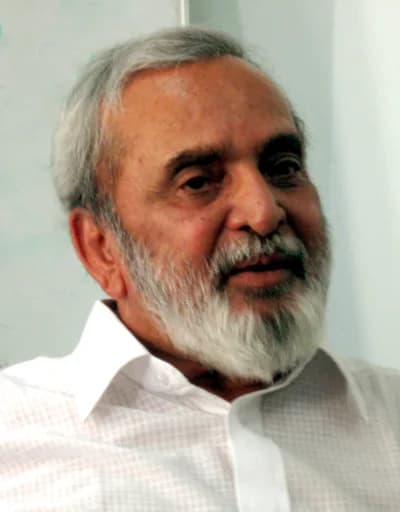
U. R. Ananthamurthy
To be modern is not a fashion, it is a state.
Biography
About U. R. Ananthamurthy
R. Ananthamurthy (1932–2014) was a Kannada-language novelist, scholar, and public intellectual who is considered one of the most important figures in modern Indian literature. Born Udupi Rajagopalacharya Ananthamurthy in Thirthahalli, Karnataka, he was educated at the University of Mysore and the University of Birmingham, where he wrote his landmark novel *Samskara* (1965) as a doctoral student.
The novel — about a Brahmin community's crisis of ritual and modernity — was translated into English in 1976 and is now a cornerstone of postcolonial South Asian literature. He served as chairman of India's Film and Television Institute, the Sahitya Akademi, and the National Book Trust, and was considered for the Nobel Prize. He was associated with the Navya movement in Kannada literature, which brought modernist techniques and social critique to regional Indian fiction.
He was an outspoken critic of Hindu nationalism throughout his career.
Key Themes
Quick Facts
- Born
- 1932
- Died
- 2014
- Lifespan
- 82 yrs
- Quotes
- 5 collected
Photo: Thachan.makan at Malayalam Wikipedia / CC BY-SA 3.0 / Source Resized and converted to WebP from the original.
Wisdom
U. R. Ananthamurthy's Famous Quotes
“To be modern is not a fashion, it is a state.”
— Various speeches and essays
Ananthamurthy was a public intellectual who served as chairman of India's Film and Television Institute and the Sahitya Akademi. He consistently argued that modernity is not a Western import but a universal condition of being fully present to one's own time — requiring a willingness to question inherited authority structures, including those of caste, religion, and patriarchy. This made him controversial in Hindu nationalist circles.
“The world is not divided by lines, but by stories.”
— Samskara: A Rite for a Dead Man (1965; English translation 1976)
From Ananthamurthy's most internationally known novel — about a Brahmin community's crisis over how to perform last rites for an unorthodox member — this theme of stories as the real boundaries between human groups appears throughout his work. Official borders and political categories are secondary; the stories communities tell about themselves and others are what create and sustain separation. The novel was made into a Kannada film that won the National Award.
“Tradition becomes our security, and when the mind is secure it is in decay.”
— Widely attributed to Ananthamurthy; this line originates with philosopher J. Krishnamurti, Think on These Things (1964)
This precisely worded observation belongs to the Indian philosopher Jiddu Krishnamurti, from his 1964 book of talks with students. Krishnamurti argued that the search for security — in tradition, in ideology, in belief — produces exactly the stagnation it seeks to prevent. While the quote circulates under Ananthamurthy's name — he shared Krishnamurti's critique of inherited authority — the original authorship is Krishnamurti's.
“A writer is a person who tries to make sense of the world.”
— Bharathipura (1973)
Ananthamurthy's fiction is built on the idea that the writer's task is not decoration or entertainment but comprehension — the strenuous act of making sense of experience that would otherwise remain raw and meaningless. His own writing process was famously slow and revisionary; he once said that he could write only when he fully understood what he was trying to say, not as a way of discovering it. The writer as sense-maker rather than sense-displayer.
“We are all prisoners of our own experience.”
— Bharathipura (1973; English translation 1994)
Ananthamurthy's landmark Kannada novel — about an educated Brahmin who returns to his village and attempts to challenge the caste system — returns constantly to the theme of how individual experience shapes and limits understanding. His characters are prisoners of their community's inherited categories, unable to see outside the conceptual framework that their particular social position has built around them. He was considered the leading voice of Navya (New Wave) Kannada literature.
From the Blog
Related Reading
Discover
More Thought Leaders
Need to Know
Frequently Asked Questions
U.R. Ananthamurthy (1932–2014) was a Kannada-language novelist, scholar, and public intellectual who is considered one of the most important figures in modern Indian literature. Born Udupi Rajagopalacharya Ananthamurthy in Thirthahalli, Karnataka, he was educated at the University of Mysore and the University of Birmingham, where he wrote his landmark novel *Samskara* (1965) as a doctoral student. The novel — about a Brahmin community's crisis of ritual and modernity — was translated into English in 1976 and is now a cornerstone of postcolonial South Asian literature. He served as chairman of India's Film and Television Institute, the Sahitya Akademi, and the National Book Trust, and was considered for the Nobel Prize. He was associated with the Navya movement in Kannada literature, which brought modernist techniques and social critique to regional Indian fiction. He was an outspoken critic of Hindu nationalism throughout his career. U. R. Ananthamurthy lived 1932 – 2014.
Morning Practice
Continue Your Daily Reflection
Daily faith-based affirmations and quotes from inspiring thinkers like U. R. Ananthamurthy.
Free access. New quotes & reflections every day.